If you’re kicking off new SEO and paid media strategies at the same time, you’re going to end up with at least two audits, two sets of recommendations, and two teams who are oblivious to each other’s priorities or think theirs should be tackled first. We’ve written elsewhere about how to prioritize the findings inside a technical SEO audit, but before you even start thinking about a single audit’s list, it helps to step back and see how the two lists fit together. How do you help both teams hit their own goals while making sure they’re working together?
We asked Rich Bianchi, who runs technical SEO on many of our client accounts, and Geneva McNamara, who oversees omnichannel marketing. This is an edited version of their conversation.
Why Do In-House SEO and PPC Teams End Up in Silos?
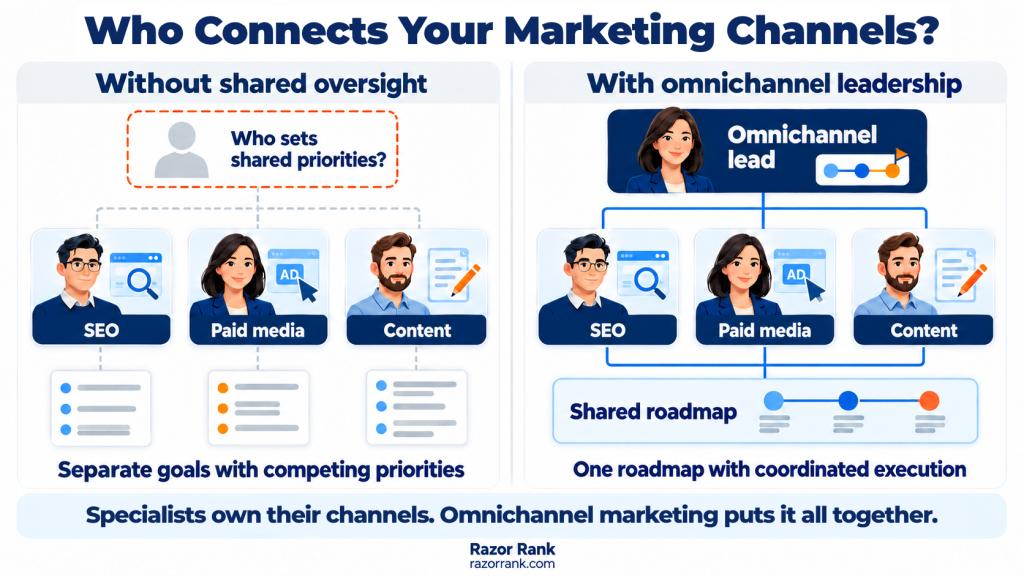
Geneva: It’s usually not because anybody designed their in-house team that way. A company that takes marketing seriously will hire a PPC manager, an SEO manager, and then maybe people for social media, content writing, and design, if their budget is big enough. All of them tend to be good at what they do, but nobody’s job description includes pulling it all together. Everyone has their own goals and their own roadmaps, so everyone works on their own list of priorities, and the lists never get compared against each other. Even when a company’s whole marketing team is one person, that person is stretched so thin that they end up doing SEO on Monday and ads on Tuesday, with no time to see how the two connect.
Rich: And from the inside, that doesn’t usually look like a problem. Every team is delivering something; everybody’s busy. The SEO manager is working through their SEO findings, the paid media manager is working through the paid findings, and both of them are making progress. You only notice there’s an issue when you put the two lists side by side and realize the paid team’s fourth item would have made you more money than the SEO team’s first item.
What Does a Director of Omnichannel Marketing Do?
Geneva: My job sits above both practices, so I get to look at what SEO is working on and what paid is working on and ask where they’re helping each other and where they’re getting in each other’s way. Should this content campaign line up with that paid campaign? Are we sending both channels to the same landing page, or did we unnecessarily build two of them? Does the brand come across the same way in both places? Those questions are hard to ask from inside a single channel because you’re only being measured on that channel’s success.
Smaller businesses almost never have somebody in a role like mine, and I understand why. You’ve already paid for three specialists. It’s hard to go back and ask your CFO for a fourth person whose job is coordination because it makes it look like someone isn’t doing their job, so the coordination either happens in somebody’s spare time or it just gets overlooked.
Rich: With an agency like Razor Rank, you get that coordination and oversight as part of the arrangement. Nobody has to fund a separate headcount for it, and you get somebody who’s seen how multiple channels interact on dozens of accounts.
Can Audit Tools Decide What to Fix First?
Rich: No, and I’d be wary of anyone who tells you otherwise. Semrush likes to flag the length of a page’s meta title as a critical issue, but in practice it makes very little difference for your organic visibility. Meanwhile, you can have one broken link in a footer, and that might not get scored as urgent at all, even though fixing it cleans up every URL on your site. The automated tools assign scores by issue type. They have no idea how many times that issue appears on your site or how harmful it really is.
Geneva: Paid audits are reliable for what they cover, which usually includes account, campaign, and conversion settings. Those catch most of the existing setup errors that we encounter. Some of the most expensive problems I’ve run into, though, are ones you’d only catch by having a real person dig into the account. I had a legal client spending a five-figure monthly budget in a big, competitive metro area where all the settings were correct, but they weren’t getting any signed cases from their ads. There wasn’t a setup error we could fix for them; their budget simply wasn’t large enough to compete in the market they were after. We moved the same ad spend to a smaller market nearby, and it started producing several signed cases a month.
Automated tools won’t point that out for you, because nothing is technically misconfigured. It’s just a judgment about where your money is likely to go the farthest, and our team is only able to act on those hunches because we have so much experience with accounts like these.
What Can an Agency Learn from Its Other Clients?
Geneva: That experience is really hard to replicate in-house. We have so many clients with accounts in the same verticals, like legal, so when a client tells me what they want to spend and what they expect to get back, I can compare that to the data and my knowledge from comparable accounts and tell them what’s realistic. Budget expectations sometimes start out a little pie in the sky, and showing a client real numbers from businesses like theirs is the easiest way to bring things back down to earth.
Rich: I know I’ve lost count of how many sites I’ve worked on. An in-house person might spend five years going deep on one site, and their experience is valuable because they’ll know that brand better than I ever will. But they’ve only seen one site’s worth of problems. I’ve watched the same issue come up again and again on dozens of sites, so when I see the same thing happening, I can usually tell how urgently the solution needs to be prioritized, because I know what happened the last dozen times.
Geneva: It carries over from month to month, too. Something we figure out on one account in March might show up in a different account in June, and the second client gets the benefit of that solution without having to pay us for the time it takes to come up with it.
What Happens When the Right Fix Is Too Expensive?
Geneva: We had a client who sells school furniture online, and when we audited their site for conversions, we found checkout problems that would have taken their developers a long time to fix. Instead of asking them to push everything else aside, we came at the problem from the SEO side and the paid side at once. Our SEO team added clarifications on the pages where confusion was costing them conversions, and on the paid side we routed traffic to alternative landing pages that avoided the worst of the checkout experience. It cost a fraction of what a full rebuild would have, and it earned back a good chunk of what the rebuild would have gotten them.
A team that only handles one channel couldn’t have pulled that off. You need somebody who can make changes on the SEO side and the paid side at the same time, and who can keep both teams working toward the same deadline.
Rich: The same thing happens on the SEO side. Sometimes we might recommend a cheaper option, like moving a site off an aging custom build onto WordPress, and the client’s resistance has nothing to do with the dev cost. They’re worried about security, or nervous about breaking something that’s been “working” for years, even if it wasn’t working that well.
Can One In-House Hire Cover Both SEO and Paid Media?
Rich: You can hire a generalist who’s competent at both, and plenty of companies do that by hiring a single marketing manager, but they could easily be lacking the depth of expertise that can only come from a full team. Technical SEO and content are different jobs, and inside paid media, legal is a different universe from ecommerce. I came up through multifamily apartment marketing, while one of our SEO directors is also a licensed attorney. When I find something in a new account that feels outside my wheelhouse, the person who has seen it is just a few desks away.
There’s a tradeoff, of course. Someone on your own staff is going to know your business better than we will, and that’s not nothing. They just can’t bring five other people’s experience to the table too.
What Should You Ask Before Hiring a Marketing Agency?
Geneva: I’d ask whether they work from one roadmap or a separate one for each channel, and who owns it. Ask what happens when SEO and paid want different things to happen in the same quarter, and who’s there to weigh in on that decision. If you get the sense that each team works on its own priorities and delivers separate reports, then you’re just paying for two specialists and still doing the coordination yourself.
Rich: You should also decide how much website access you’re prepared to hand over before you sign anything. If you hire an agency but then make every development recommendation sit through an internal review that takes six weeks, you’re paying for help you can’t really use, and whatever you saved by not hiring your own people goes right back out the door.
If you’re weighing an in-house vs. agency decision for your own digital marketing strategy, we’d love to continue this conversation with you. Get in touch with us and we’ll show you how we’d coordinate our work across each of your marketing channels.
Razor Rank is a full-service digital marketing agency specializing in SEO, paid media, CRO, and web. We help businesses grow through data-driven strategy and measurable results.