A personal injury firm we work with had been running Google Ads for about a year. They were getting calls at a pretty high volume, the phone was ringing all day, and they were very happy with the pace, but only about one in twenty of those calls became a signed case.
You can probably guess what questions our client was asking themselves. What’s wrong with our ad account? Is it the keywords? Are the landing pages weak? Should we talk to a different agency? I’ve been in plenty of those meetings, and I’ve asked some of those questions myself.
In my experience, the first thing that gets questioned is the ad account because, for most law firms, the ad account is the only part of the process they have visibility into.
Why Lead Quality Problems Look Like Ad Problems
The scene that plays out at firm after firm usually goes like this: The intake team isn’t signing people up, so the first conclusion is that their leads are junk. They aren’t qualified, and they aren’t the kind of client the firm wants. From there, they start scrutinizing the ads they’re running on Google. The targeting must be wrong, or the keywords must be too broad, or the agency must not know what it’s doing. Why are they spending this kind of money on leads that don’t turn into cases?
It’s not that this isn’t sound reasoning. If lead data is all you have, that’s exactly where you should start looking. Lead volume and cost per lead are the levers you can see, so they’re naturally the levers you reach for.
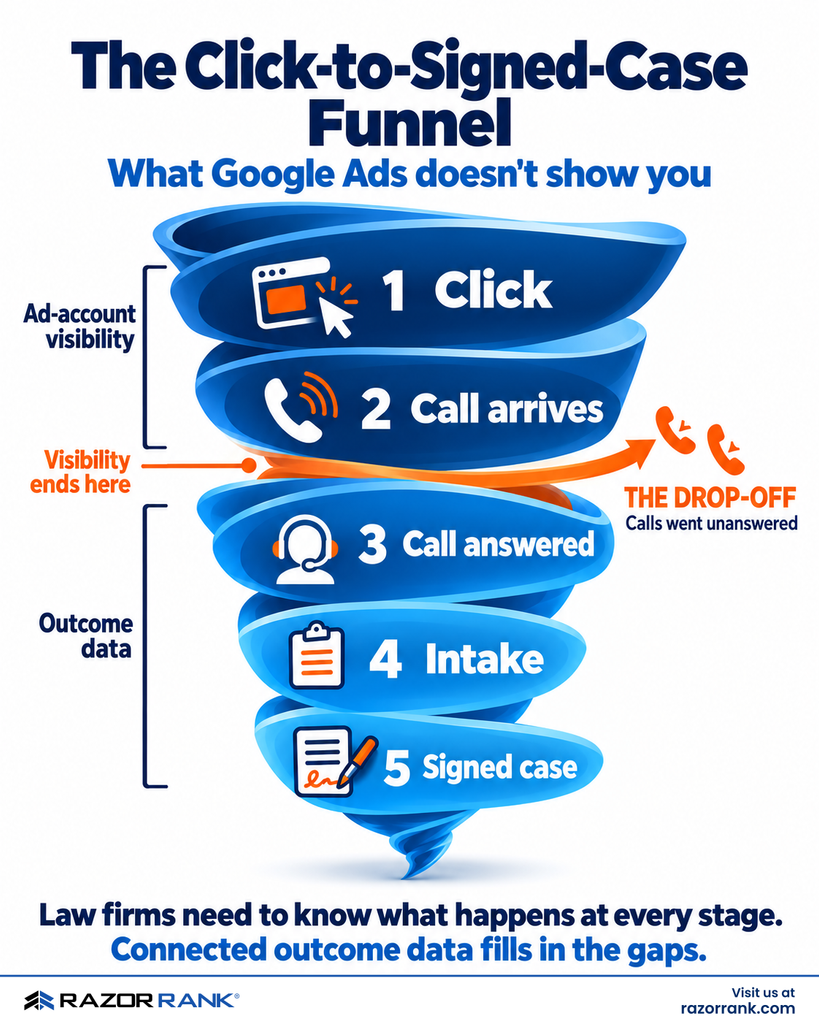
The Google Ads platform can see who clicks through to your website, but that’s where its visibility ends, unless you give it some help.
Google Ads can’t see whether the person who called you had a real case. It doesn’t know whether anybody at your firm picked up the phone. It doesn’t know whether your intake team called back three times and never reached them. And for the first few days, you don’t know those things either, because you don’t find out what a call was worth until somebody chases down the facts, the liability, and the policy, and finally signs the client.
I gave a talk at the PILMMA Super Summit this year about what a lack of visibility can cost a law firm and how to fix it, so I won’t repeat the whole argument again here, but you can watch the session if you want to learn the exact mechanics.
Lack of visibility comes with a second cost, though, and I don’t think it gets talked about enough. When ad-account data is the only data you have, you can really only diagnose issues within your ad account. Your entire vocabulary for what might be wrong is cost per click, cost per lead, and impression share, so that’s naturally where you try to adjust.
That’s also why so many of the recommendations that law firms receive are restrictions. Agencies and consultants tell you to tighten the geography, stop advertising overnight, and add more negative keywords. Get the cost per click down from $500. Those are all defensible pieces of advice, and some of them may be right. But you’ll notice that all of them are ways to spend less, because spending less is the only move you have available when you can’t tell what ad spend is working and what isn’t.
You can run a full year of competent optimization trying to fix a problem that might not even be an ad account problem. In our personal injury client’s case, the problem was actually with their intake process rather than the ads themselves.
The Data You’re Missing: Why Clicks Don’t Become Signed Cases
We put this firm on our proprietary platform, Full Circle Attribution™, which connects their call tracking, intake, and case management systems back to Google Ads, so every lead shows a real outcome. With Full Circle Attribution, we can answer more questions: Did somebody answer the call? Did it become an intake? Did it become a signed case, and what was that case worth?
The reason I want to tell you about this particular firm is that once we dug into the FCA data, we didn’t see what we expected to. We turned it on assuming we would find out which campaigns were producing signed cases and which were producing junk leads, which is the usual story.
What we found first was that the firm had plenty of intakes. Not just calls, but intakes: cases the firm had looked at, liked, and intended to follow up on. The leads were far from junk, and the targeting was not the problem.
What stood out instead was the share of those intakes that went on to become signed cases. It was very low, which was a sign of something other than issues with the ad account. So we went into the data in their call tracking platform, and found that the firm’s own team was calling leads back and not reaching them.
We turned away from the ads and audited the firm’s intake process instead. We investigated how calls were routed, who picked them up, and what happened to the calls that arrived during busy stretches. We found two major culprits that hadn’t been caught before.
Some of the firm’s phone numbers had never been properly registered, so they were coming up in Caller-ID as spam. When the intake team called a lead back, 90% of those callbacks came to prospective clients’ phones as spam calls, and therefore the leads never picked up their phone calls.
We pointed out the issue and worked with the firm to fix it. Within 30 days, the number of Google Ads calls that turned into signed cases had increased by 15 additional signed cases per month.
Let’s focus on that for a second, because that’s the part that should bother you. The campaigns that the client was running were capable of producing cases the whole time. In fact, they had been producing potential cases, but those cases were arriving and then falling into a hole that nobody had visibility into. Full Circle Attribution™ provided the information they couldn’t see and allowed us to fix the problem.
Where to Put Your Budget When You Can See Signed Cases
Once intake was repaired and the numbers could be trusted, the firm could finally make budget decisions based on what campaigns produced cases rather than what campaigns produced calls.
With cost per signed case visible at the campaign level, we could see which campaigns were producing signed clients and which were producing calls that went nowhere. The same was true one level down, at the ad group, the keyword, and the geographic area, and across the different bidding strategies the account was running.
That changes the question from “How do we spend less?” to “Where do we spend more?”. Budget gets reduced for the campaigns generating leads that don’t sign, and goes toward the ones producing clients. Some of those campaigns carry higher costs per click than the firm would have tolerated a year earlier, because an expensive click that becomes a signed case costs the firm less than a cheap click that produces no revenue.
Questions to Ask About Your Google Ads Data
Even without access to the insights that Full Circle Attribution provides, you can ask yourself a few questions that will tell you whether you have a visibility problem.
What share of your calls become real intakes?
You’re not looking at number of calls answered or number of forms filled out. You’re looking at intakes: the ones where your team looked at the details, decided they liked the case, and moved to send a retainer.
What share of those intakes become signed cases?
A firm can have healthy intake numbers and a weak signing rate, and the discrepancy usually points to something other than the advertising, like problems with the intake process.
Can you trace intakes and signed cases back to a campaign, ad group, keyword, or practice area?
If you can only see these numbers for the firm as a whole, the average masks details about the campaigns that produce everything and the ones that produce nothing.
When a lead doesn’t convert, can you tell whether nobody wanted it or nobody answered it?
These two problems are very different and should be solved in different ways, but from inside the ad account they look identical.
Can you see which campaigns and practice areas are producing your signed cases?
Lead volume by campaign is easy to get. Signed cases by campaign is the number that should be driving your budget, and most firms can’t produce it without specialized insights like the ones that come from Full Circle Attribution™.
Were the last three recommendations you received all about reducing something?
Has an agency told you that you need a smaller targeting radius, fewer advertising hours, or cheaper clicks? Restrictions usually get recommended when nobody can see what spending is actually working, and where you should double down. Quite often your higher-cost clicks become good signed cases, but in 99% of cases you have no way of knowing this.
How to Use Google Ads Outcome Data
Accurate attribution is the only thing that gives you the ability to optimize a campaign toward signed cases. Most accounts are optimized toward getting more leads, or lower-cost leads, which may or may not become signed cases.
By knowing which clicks became cases and reporting real outcome values back to Google, you can tap into Google’s AI modules, which learn which clicks are your most valuable, prompting it to send you more of those.
Before you can get to that, though, the first step is diagnosis. Before it makes your advertising smarter, Full Circle Attribution™ tells you whether your advertising is a problem at all. For our client, it wasn’t, and adjusting the ads wouldn’t have been the right solution for them.
If you’re not sure where your leads are dropping off between the click and the signed case, we’re glad to take a look and tell you what we see. Get in touch and we’ll get you started on your way to smarter ad spend, more clarity, and more signed cases.
Razor Rank is a full-service digital marketing agency specializing in SEO, paid media, CRO, and web. We help businesses grow through data-driven strategy and measurable results.