Generating content has never been easier than it is today, thanks largely to the proliferation of AI tools. Anyone can produce a thousand words on almost any topic in under a minute, and a lot of sites do just that on a regular basis. Everyone who spends time online knows this by now.
What a lot of content producers don’t realize is that the basic production of content and producing content worth reading are two different skills. Anyone can put paint on a canvas, but very few people can paint something you’d want to look at more than once or really engage with. Content works the same way, and the differences between great content and just-okay words on a page have changed now that the creation part has such a small barrier to entry.
The other part of the creation process that gets less attention is that when content is this cheap and easy to make, websites can accumulate pages faster than anyone can maintain them. Five blog posts might end up covering pretty much the same topic from only slightly different angles, and no one can say why any individual page deserves to exist. Readers can’t tell which one answers their question, and neither can Google, so these pages either get left out of search results and AI Overviews entirely, or the wrong ones get returned.
Why Old Content Stops Ranking
As any site manager who’s been publishing content for a decade or more knows, this problem actually existed long before AI came on the scene. The content strategy used to be: Pages get written, they rank, and then nobody touches them again. Meanwhile, the standard for great content has evolved since these pages were created.
Some of that content is still fundamentally sound and just needs updates, like the addition of current statistics, up-to-date service descriptions, or modern examples that reflect how a business operates nowadays rather than ten years ago. A page walking through pandemic-era operating procedures isn’t going to be useful to a site visitor today outside of historical context, and it can’t be rescued by a rewrite.
If we take the example of pandemic-era pages and apply this lack of maintenance site-wide, the consequence becomes very clear. You’ve got a body of pages that no longer serve anyone.
What Happened to Google’s Helpful Content Update
Google’s helpful content system originally launched in August 2022 as a standalone update and was later folded into the core ranking system as of March 2024.
Two things resulted from that:
- There’s no update to wait out if a site is being held back by a mass of weak pages. Google’s assessment is happening every day rather than on an algorithmic schedule.
- The effect is site-level rather than page-level. A large enough share of unhelpful content can suppress the pages that would otherwise perform.
This is why “just publish more” has gotten riskier as a strategy. Volume used to be close to free as long as you had enough content around a topic. Now every page that doesn’t stand out and earn its place is a small drag on everything around it. Content must be helpful for Google and other search engines to want to surface it.
How to Decide What to Refresh, Consolidate, or Delete
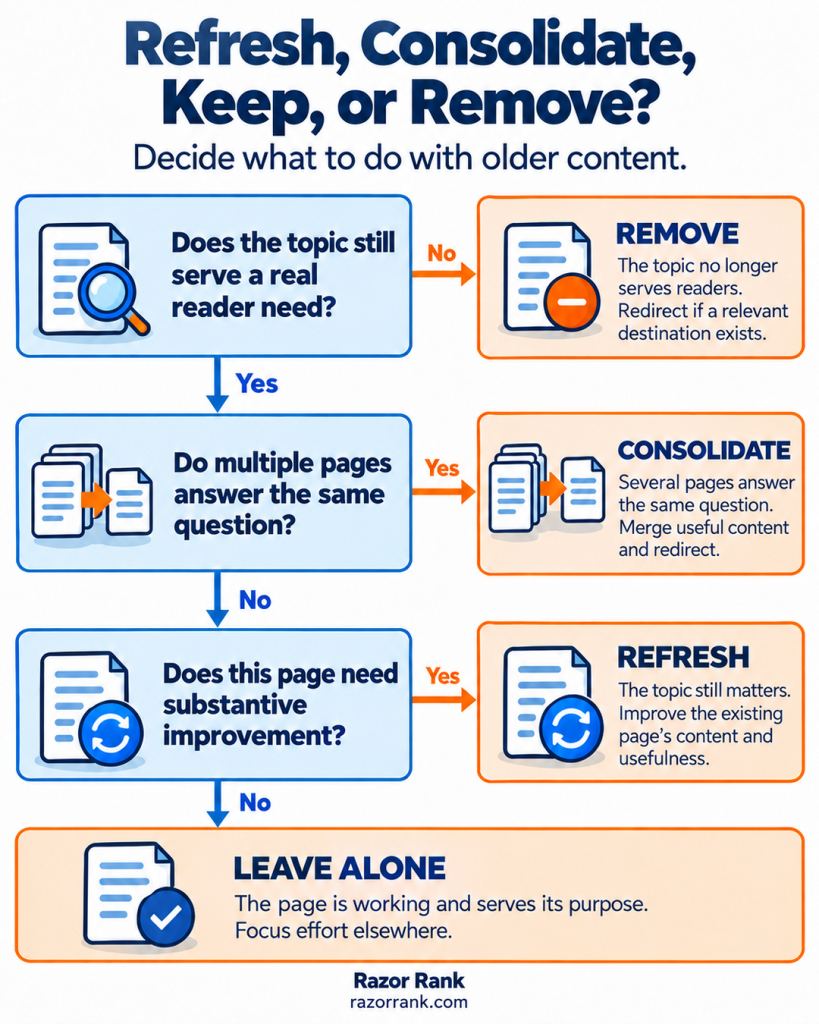
The easy part of a content audit is finding the underperforming pages. There are tons of tools capable of handing you a list. The hard part is deciding what to do based on the data these tools provide. The solution you choose for each old piece of content relies on three questions:
Does this page have a reason to exist? We’re not asking how much traffic the page earns; the question is whether some real person is asking something this page is the best answer to.
Are there other pages that serve the same purpose as this one? In order to avoid competing with each other, every single page of a website should serve a singular purpose, or answer a question, that no other page can.
Does the content need improvement? A page on a topic that still matters, written thinly or written years ago, is fixable, but a page on a topic that no longer matters isn’t.
Those three questions sort almost every piece of old content into four outcomes:
Remove the Content Entirely
The topic is genuinely dead. Redirect it to the closest relevant page or parent page if one exists.
Consolidate Similar Pages
Several pages are competing to answer the same question. Pick the strongest one, merge what’s useful from the rest into it, and redirect the others so the accumulated authority has somewhere to go.
Refresh the Content
The topic still matters and the current page is the right home for it. Give it an update with current stats, modern context, or more robust information to keep the page fresh and relevant.
Leave the Page Alone
The page is working. There’s an opportunity cost to touching pages that don’t need it.
How to Substantively Refresh Old Content
Updating the publish date and swapping a year in the title doesn’t count as a content refresh. Google has said directly that changing dates to make pages look fresh, without meaningfully changing the content, isn’t what freshness signals are for.
A real refresh means the page comes out better than it was before. In practice, that could include:
- Statistics and figures replaced with current ones, and sourced
- Services, products, and pricing brought in line with what the business actually offers today
- Examples and screenshots that match how things currently work
- Recent wins, results, or first-hand experience added where they’re relevant
- Page structure reworked so the answer to the page’s core question comes early
- Internal links updated, both into the page and out of it
The reason that refreshing pays off faster than publishing something new is that existing pages already have history with Google. They’ve been crawled, indexed, and may already have links pointing at them. A brand-new page starts from nothing and must spend months building up topical authority that longer-lived content already has.
Why a Content Refresh Takes Most Teams 3 to 6 Months
For most in-house teams, a content overhaul of any size runs three to six months. This timeline includes the audit, the page decisions, the rewriting, and the technical work of redirects and internal linking. Each step in the process has to compete with whatever else the team has scheduled during a marketing cycle. The implementation work gets done when there’s time, and more often than not, there isn’t much time to do it.
Calendar time is only part of the cost, though. Site visibility also slowly declines from a lack of action and change. A user doesn’t find a stale, decaying site useful, and neither will Google.
Where to Start on Your Own Content
Razor Rank is able to do this work on a compressed timeline because it’s the work we do every week, with a process and a team already built for it. If you’re looking back on years of content with no clear sense of what’s helping and what’s holding you back, get in touch with us for an audit that provides real answers and next steps, and then let us help you get the work done faster.
Razor Rank is a full-service digital marketing agency specializing in SEO, paid media, CRO, and web. We help businesses grow through data-driven strategy and measurable results.