AI Overviews summarize an answer to a user’s search query instead of listing links, which changes what gets a web page cited. Ranking well is no longer enough on its own; the page also has to be built so a model can extract a confident answer from it without extra work. Two pages can rank next to each other in standard results and still perform very differently in AI Overviews. What sets them apart is usually content and data structure rather than authority.
The five changes described below moved one of our client’s pages, a B2B advisory firm in a heavily regulated industry, from largely absent in AI Overviews to consistently cited for its target queries. Each one is a structural change rather than a content or authority change. We’ll describe how the client’s page was structured before our engagement started, and then explain how each of our tactics improved the page’s likelihood of being cited in AI Overviews, with real-life examples in each step.
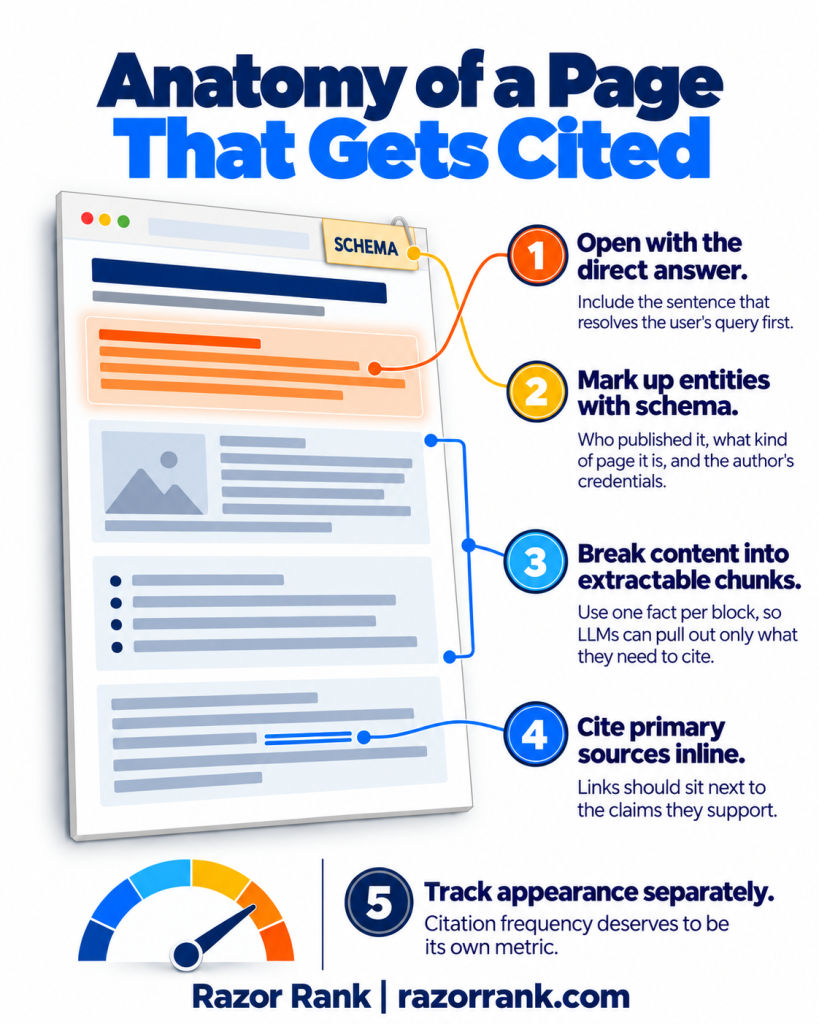
Our five primary focus areas:
- Open each section with the direct answer, ahead of the setup around it
- Mark up entities with schema so the relationships between them are explicit
- Break long sections into chunks a model can extract as a single fact
- Cite the primary source inside the page itself
- Track AI Overview appearance as its own metric, separate from ranking position
Open Each Section with a Direct Answer
Put the answer to the user’s query first, ahead of any framing around it. A page addressing the difference between two overlapping regulatory frameworks should name the actual distinction in its first sentence, not farther down the paragraph where LLMs are forced to spend more effort finding it.
Before: The section opened with two sentences on how two regulatory frameworks share the same broad goal and originate from the same standards body, then stated the actual distinction afterward.
After: The section opens with the distinction, then explains why it matters for the reader’s specific situation, and closes with the exception that changes which framework applies.
Google’s guide to succeeding in generative AI features doesn’t publish extraction logic, but it does ask for content that is clearly organized and directly useful. In our experience across client accounts, a correct answer placed in a third sentence gets picked up less often than a weaker one that’s the first thing in the relevant paragraph. This is the fastest fix on the list, since it reorders sentences that are already written. It’s also the one most of our client’s existing pages needed most, because compliance content in particular opens with scope and context before it gives an answer. That ordering reads well to a person building a mental model of a regulation, but it works less well for a system that reads a first sentence and then stops expending energy on the crawl. Moving the answer up doesn’t change anything about the accuracy of the content; it just makes it more citable.
Mark Up Entities with Schema So Relationships Are Explicit
Add structured data in the page’s underlying code that names the page’s entities and how they relate, so a machine reading the page doesn’t have to work it out.
Before: The site’s content, service, and organization pages carried no schema tying them together. A blog post, an FAQ, and the service page it supported all existed as separate documents with no machine-readable relationship between them.
After: We performed an audit of five schema markup types — Organization, Breadcrumb, LocalBusiness, Blog/Webpage, and FAQ — to establish what was present and what was missing. Then we got to work on two fixes: enhancing Service structured data to separate pages meant to educate from pages meant to bring in business, and inserting markup identifying the in-house experts behind the content, including their certifications from regulatory governing bodies.
Google states in its own documentation that there is no special structured data you need to add to appear in AI Overviews or AI Mode. Nobody should add schema markup with the expectation that it will directly improve AI visibility, and we didn’t.
What schema does is state facts about a page that would otherwise have to be inferred: What kind of page this is, who published it, and how it connects to everything else on the site. LLMs are not great at inference. You won’t see any errors in your tools if your structured data isn’t precise or complete; it just won’t get read correctly by AI models, or it’ll get passed over. Removing the guesswork is an important factor in organic visibility generally, whether the thing reading the page is a crawler, a browser agent, or a model assembling an answer.
The credentials markup is the clearest example. In a regulated field, the difference between an explainer written by anyone and one written by someone holding a certification from the relevant governing body is invaluable, and prose alone leaves a machine to figure that out from context. Naming the person and the certification in underlying markup makes it easy for AI models to see and parse. The same logic applies to separating educational pages from commercial ones: Both may cover the same regulation, and only one of them is trying to sell something.
Running an audit of structured data first, before touching any markup, helped us organize our fixes. We weren’t aiming to add every available schema type to the site, but to find the specific places where a machine would otherwise have to guess, and resolve those. Organization markup in particular is the piece most sites either skip or get wrong, since it establishes who is publishing everything else on the site.
Break Content into Chunks a Model Can Extract
Split dense paragraphs into shorter blocks, each covering a single fact or instruction, so a model can extract one without pulling in unrelated material around it.
Before: A page covering several distinct requirements under one regulation stated all of them in a single paragraph, because the requirements are related enough that grouping them felt natural to write.
After: The same content splits into one short block per requirement, each with its own heading or topic sentence, so a reader or a model can easily find one without wading through the rest.
AI Overview summarization selects individual units from a page and stitches them together, rather than compressing the whole page start to finish. A page built in large undifferentiated blocks gives the system fewer clean units to pull from, so it either skips past the page or, while it’s pulling in content, picks up unrelated context along with the fact that’s needed. The result is that the page doesn’t show up in AIOs, or shows up truncated in a way that misrepresents the point. Both of these problems are hard to diagnose from normal ranking reports. For us and this client, this mattered more in regulatory content than on most other page types, because the source material is naturally dense and the easiest option is to keep related requirements together in one paragraph.
Cite Primary Sources Inline, Next to the Claim
Put a citation to the authoritative source directly in the body, next to the claim it supports, rather than only linking out in a resources section at the bottom of the page.
Before: A claim about a specific regulatory requirement stated what the rule required with no link to the rule itself, relying on the page’s own authority.
After: The same claim is followed immediately by a link to the specific section of the regulation or the agency guidance it’s based on, placed at the sentence level rather than the page level.
A page that already shows where its claims come from reads as more reliable to a system that needs to be confident in its citations. This is especially true in regulatory content, where a reader, or a model deciding whether to trust the page, can check the citation against a primary source that doesn’t change its meaning based on who’s summarizing it.
How to Track AI Overview Appearance Separately from Rank
For clarity, set up reporting for whether a page is cited in an AI Overview, tracked separately from where it ranks in standard results.
Before: The client’s reporting covered ranking positions and organic click-throughs only.
After: Our reporting adds appearance frequency in AI Overviews for the account’s target queries, tracked query by query rather than as a sitewide average.
This type of reporting requires a third-party tool (we use Semrush). Google folds AI Overview and AI Mode appearances into overall Search Console traffic under the “Web” search type rather than breaking them out as their own report, so Search Console by itself won’t tell you whether a specific page was cited for a specific query.
What the tracking showed: Over our two-year engagement with this client, citations in AI Overviews went from 1 to a healthy baseline of 54. Across that same period, keywords ranking in the top ten rose 988%, and organic visibility, measured as a composite score, climbed from under 1% to 17.4% once our efforts really began to build on themselves. Traffic from AI sources grew 116% year over year.
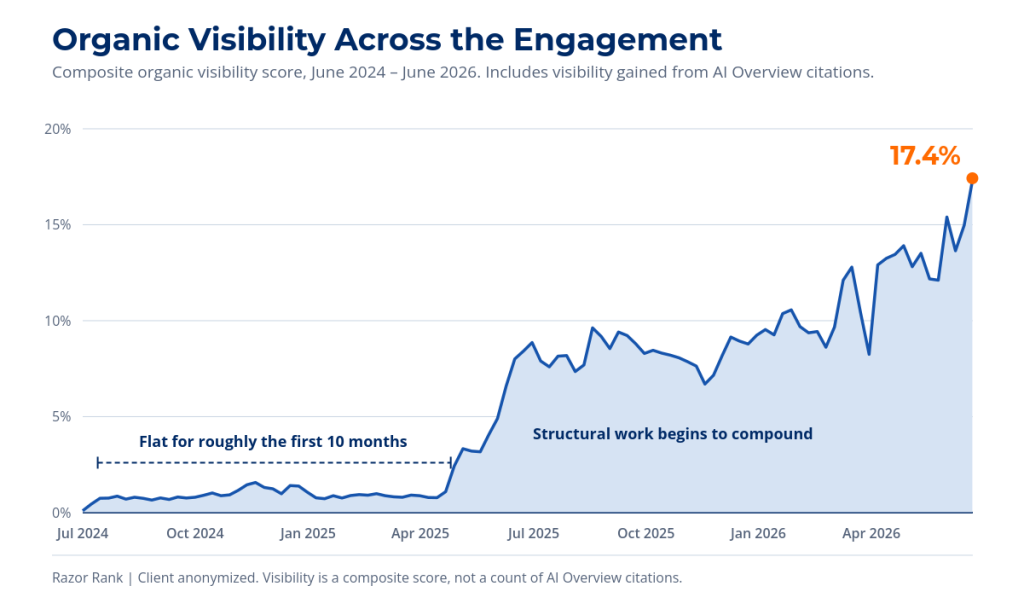
As you can see in the chart, visibility can sometimes take time to start climbing, and the climb isn’t always perfectly smooth because of core updates and changes in the way AIOs work. Structural work on an established site doesn’t result in an immediately huge lift, and anyone promising that it will is selling something else.
A page can hold position five in standard results and never appear in an AI Overview for the same query, or it can appear consistently in the AI Overview while sitting outside the top results. Those are different visibility gaps caused by different things, and if you report only on rankings, you miss the opportunity to diagnose and fix your visibility at the very top of the search results. Query-by-query tracking also shows which of your fixes is having the most impact on AIO citations, helping you double down on what works best.
What’s Included in an AI Overview Audit?
Getting cited in an AI Overview starts with an audit of how well AI models can read your current pages and find the information they need for a citation. This kind of audit should help prioritize different fixes than what would result from a technical or content audit, although it’s still based on the same foundational principles, since a page still has to be crawlable and indexable before anything else matters.
If your pages rank well and still don’t get cited, Razor Rank can help, just like we did for the client in this story — read the full case study here. Our audits cover how a page reads to AI models as well as how it reads to traditional crawlers, including the structural issues above. Get in touch and we’ll tell you how to outperform your competitors in AI Overviews.
Razor Rank is a full-service digital marketing agency specializing in SEO, paid media, CRO, and web. We help businesses grow through data-driven strategy and measurable results.