Updated by Christian Erickson for Google Ads best practices in August 2026
One question to think about: Are you paying wholesale, or are you paying retail in your Google PPC campaigns? Advertisers don’t usually think about PPC prices this way, but poor relevance can make you pay more for traffic, qualify for fewer auctions, and convert fewer of the clicks you buy. In a poorly managed account, those problems can sometimes waste 50% or more of their PPC budgets.
What Quality Score Means in 2026
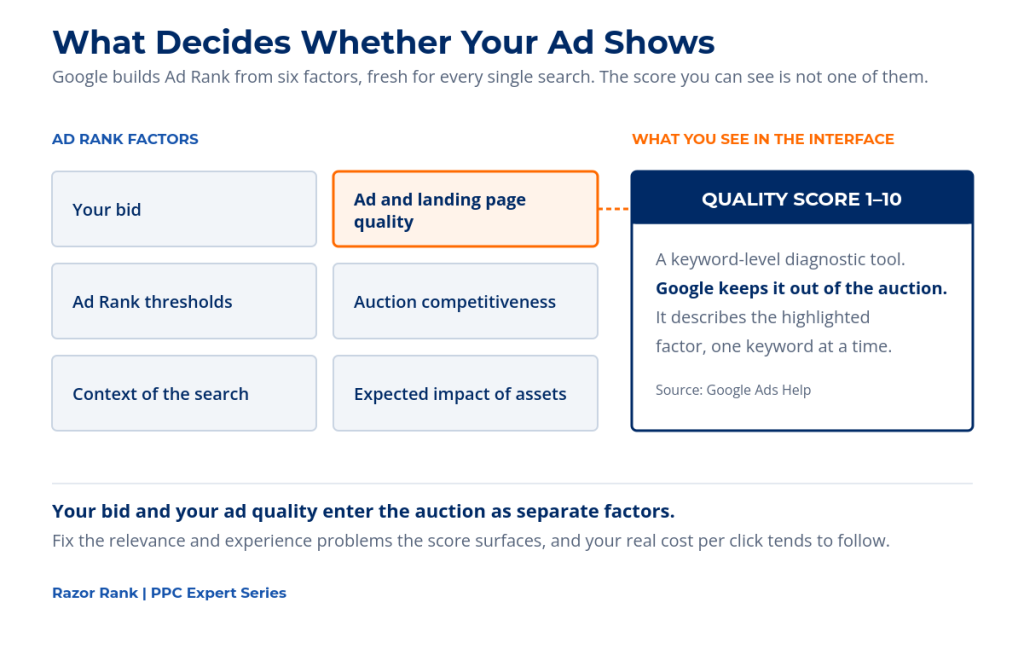
Google Ads Quality Score is a 1-to-10 keyword-level diagnostic based on expected click-through rate, ad relevance, and landing page experience. A higher score suggests that your ad experience is more relevant and useful than those of other advertisers showing for the same search. The most important thing to know is that Google does not treat the visible Quality Score as a KPI or a direct auction input. It should tell you where to investigate, but it shouldn’t become the account’s main objective. Conversion quality, cost per acquisition, revenue, profit, and return on ad spend still determine whether the campaign is working.
How Poor Quality Wastes PPC Budget
There’s no universal formula saying that moving from a Quality Score of 5 to 7 always cuts CPC by 20%, or that a score of 10 earns a 50% discount. Ad Rank, not the visible Quality Score, ultimately determines whether an ad is eligible to show and, if eligible, where it appears relative to other advertisers. Google calculates Ad Rank for each auction and ad location using six high-level factors: your bid; ad and landing-page quality; Ad Rank thresholds; auction competitiveness; the context of the search; and the expected impact of assets. Thresholds set the minimum Ad Rank an ad must clear to show, while competitiveness influences its opportunity to win a position and what the click may cost. Better quality can improve eligibility and often lower actual CPC, but the visible score itself is not multiplied by the bid.
Most bidders’ waste usually comes from the problems you can diagnose using Quality Score: loose search matching, generic ads that attract the wrong clicks, weak message match, slow mobile pages, and landing pages that don’t fulfill the ads’ promises. Increasing bids or budgets without fixing those issues is the PPC equivalent of yelling louder from the back of an auction room. You may buy more traffic without creating more customers.
The Three Ad Components to Fix
- Expected CTR: Make the offer and benefit specific, align the copy with search intent, and use a clear call to action. Do not chase clicks for their own sake; a more selective ad can produce fewer clicks but better customers.
- Ad relevance: Organize ad groups around clear products, services, or intent themes. Split mixed themes when one ad cannot credibly answer every search, and review actual search terms instead of relying only on the keyword list.
- Landing page experience: Send users to the page that best answers their search. Keep the offer consistent from keyword to ad to page, then improve mobile speed, navigation, trust signals, and form usability. Exact-match keyword repetition is less important than satisfying intent.
How Agencies Use Quality Score Now
Modern agencies prioritize Quality Score issues by spend, conversion performance, and business value. We use tightly themed ad groups rather than rigid single-keyword structures, test responsive search ads as distinct creative hypotheses, and add relevant assets. Broad match or AI Max can expand useful reach, but they require clean conversion data, appropriate Smart Bidding, search-term reviews, negative keywords, brand and URL controls, and feedback on lead or sales quality.
Don’t pause a profitable keyword merely because it has a 5/10 score. Focus first where an Average or Below average component overlaps with meaningful cost, declining conversion rate, weak lead quality, or lost impression share. Fix the user experience, test the change, and judge the result by business performance.
How to Calculate Average Quality Score, and Why We Don’t Recommend It
The old method was to export enabled keywords and calculate a simple average. Google now advises advertisers not to aggregate Quality Score. A basic average gives a low-volume keyword the same influence as one responsible for thousands of dollars in spend and encourages teams to optimize a vanity metric. Instead, here’s a better approach:
Access the Keywords in Google Ads
- Open the relevant Search campaign view, then select Search keywords.
- Set a useful date range and filter to the enabled campaigns, ad groups, and keywords you actually want to diagnose.
- Open Columns, choose Modify columns for keywords, and add Quality Score, Landing Page Exp., Exp. CTR, and Ad Relevance.
- Add the historical versions of all four Quality Score columns so you can see whether a component improved or declined during the selected period.
- Add cost, clicks, conversions, conversion value, CPA or ROAS, and Search lost IS (rank). These metrics determine which Quality Score problems deserve attention first.
Open the Search Keyword Spreadsheet
- Download the report as an Excel file or open it in Google Sheets. Keep the current and historical component columns beside the performance data.
- Sort by cost, conversion value, or another business-priority metric; not by the 1-to-10 score alone.
- Filter for Average or Below average expected CTR, ad relevance, and landing page experience where meaningful spend or lost impression share is involved.
- Group the findings by likely fix: search-term control, ad-group theme, creative, landing page, measurement, or bidding.
- Don’t pause a profitable keyword solely because its score is low. Test the fix, judge it by business results, and use the historical columns to confirm whether the underlying diagnostic changed.
This updated workflow helps you find expensive quality problems, all without pretending one account-wide average is the goal.
Stop Paying Retail for Google Ads Traffic
Quality Score still matters in 2026, but you should think of it as a flashlight rather than a finish line. Use it to find relevance and experience problems, then connect those findings to qualified leads, sales, revenue, and profit. If your costs are rising while results are falling, Razor Rank can audit the matching, ads, landing pages, bidding, and measurement behind the score. Learn more about our PPC management services or contact our team for a second opinion.
We’ll hear you, even if you’re in the back of the room.
Razor Rank is a full-service digital marketing agency specializing in SEO, paid media, CRO, and web. We help businesses grow through data-driven strategy and measurable results.