Every audit ends with a list of findings, but only some of those findings change what a visitor can do on your site. Those are usually the ones that make a difference to your bottom line. Our SEO directors have taken a look at the audits we’ve performed over the past year to pull out the patterns we recognize, which not only helps us solidify our practice, but hopefully provides some insight for our readers as well.
Impacting revenue usually means looking at SEO and CRO together, even though most agencies treat them as separate departments. SEO is responsible for whether someone can find your page and get to it, and CRO (conversion rate optimization) is responsible for what happens once they arrive on a page. If a client is ranking nicely but has a broken checkout button, then their SEO program is a success, but they still have a revenue problem. Pointing fingers between the two teams doesn’t improve sales.
At Razor Rank, we don’t draw a hard line between these disciplines. Our audits are designed to show us robots.txt errors alongside location pages with no phone numbers on them, and everything we recommend goes into the same roadmap. We’ll start with how a finding becomes a recommendation, then get into the specific fixes that paid off over the past year, plus one that didn’t. If you’re curious how we decide what goes first on the roadmap, we’ve written about that separately.
How to Turn SEO Audit Findings into Revenue
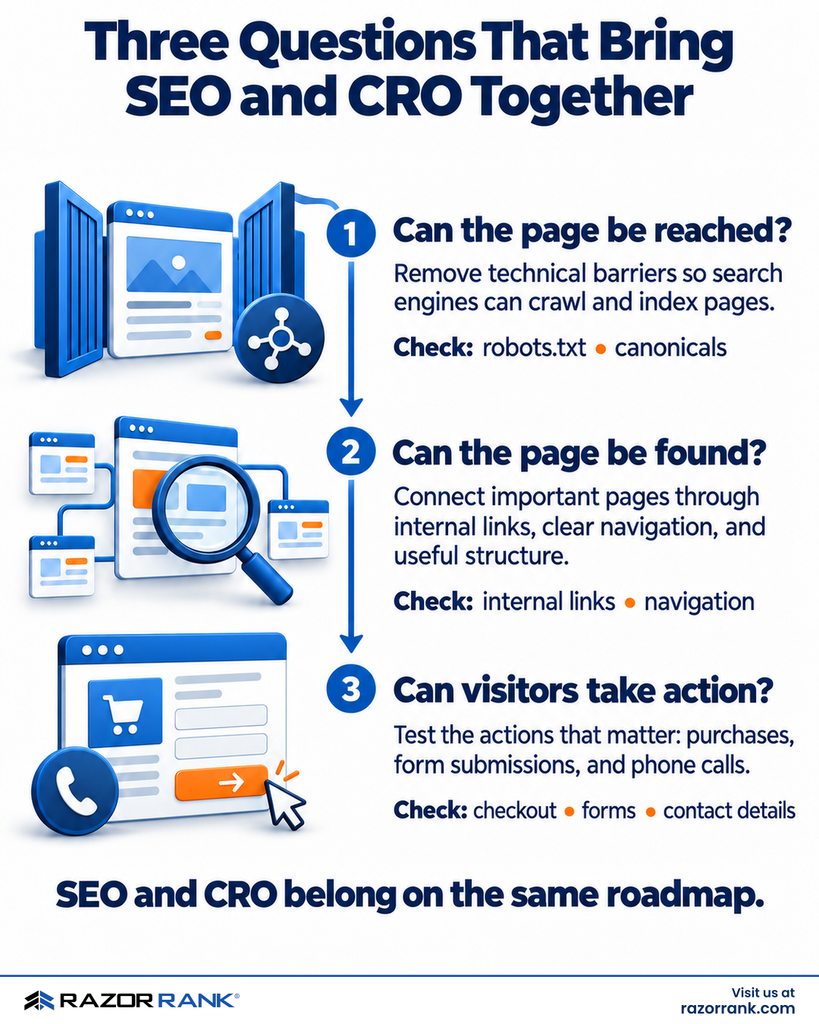
Whether it’s a technical SEO audit, a content audit, or a conversion audit, they’re all checking for three things: whether the page can be reached technically, whether it can be found by humans, and whether someone who lands on it can do what they came to do.
Logically, those three actions happen in order, which is why we fix the technical foundation first even when it’s the least exciting item on the list. If the robots.txt file is misconfigured or the canonical tags are pointing somewhere strange, most of the other items on a roadmap are wasted efforts.
“If your robots.txt isn’t set up correctly, you’re doomed. It’s like trying to swim with cement around your feet.”
Ryan Moore, Director of Enterprise SEO
Once we’ve ensured that a site can be crawled and indexed, our findings start to look different from one another. Some change how many people show up, and others change where they land or what they’re able to do once they get there. We add recommendations to the roadmap when we can say which aspect of the experience it changes and approximate how much of the site it affects.
Can You Tie SEO Fixes Directly to Revenue?
For ecommerce clients, the connection between something we fix to an increase in revenue is usually easy to see. For lead generation, and especially for law firms, it’s harder. Unless they’re using a system like Razor Rank’s Full Circle Attribution™, most firms don’t put a dollar value on an individual lead, and even when they do, we usually can’t see that number. So on those accounts, we measure success in conversions, meaning the calls and inquiries that come in.
We do know that organic visibility and organic revenue tend to rise together. When we fix the kinds of issues you’ll see examples of below, impressions, rankings, and qualified traffic go up, and the revenue the client reports from organic search goes up with them. Even when we can’t hand you a receipt that ties one internal linking project to an exact dollar amount, we can show you a visibility curve and a revenue curve bending upward at the same time, consistently, across clients in very different industries.
Why Newer Sites Have the Most to Gain from an SEO Audit
You’ll notice most of the examples below come from newer clients. When we’ve been maintaining a site for three years, there usually isn’t a silver bullet left to find because the obvious problems got solved in the first year of our engagement. Our job after fixing the biggest sitewide issues is continuously improving on what we know is working to raise bottom-line numbers even more, and making sure nothing breaks.
“For a lot of our existing clients, once we get them into a pretty good spot, our technical audits alone aren’t going to turn up something that increases revenue by 20%. Our newer clients are where we find the bigger gaps.”
Ryan Moore, Director of Enterprise SEO
New clients tend to come to us with broken internal links, disorganized URLs, location pages missing basic information, and checkout flows that nobody has tested since launch. On sites like that, a single fix can still move a number in an obvious way. Of course, plugins can sometimes break or features that previously worked just fine can stop behaving as expected through no fault of our own, which is why it’s so important to consistently check technical SEO functionality over time. But the biggest gains we earn for longer-tenured clients don’t usually come from technical SEO fixes; rather, they come from content programs, EEAT improvements, and building out new site sections.
How Internal Linking and Navigation Increase Leads
This is the category that surprises clients the most, but it’s also the first thing our team brings up when someone asks what moves the fastest.
For our wealth management client with 70 location pages, we changed one page template. The new template included a block of links to all eight of their core service pages, which turned 70 location pages into 70 strong internal links to every service. That one template change drove a 41% increase in leads across their locations.
Your main navigation works the same way, just on a bigger scale. If a service page is linked in the main menu of a 500-page site, it automatically will have 500 internal links pointing to it. We’ve rebuilt navigation for clients whose menus simply left out their main service or industry pages, which happens a lot more often than you’d think. For one biochar manufacturer, we reworked the whole structure and pulled their real products and a learning center into the menu, and the site ended up both better linked and a lot easier to get around.
“Page structure and internal link updates are probably the top two. If you fix those and make an effort to really optimize them, those can actually lead to fireworks.”
Darrin Williams, SEO Analyst
Older sites tend to have the most to gain from these fixes. Internal linking best practices in 2026 are very different from how they were in 2012, and we often inherit domains with valuable blog archives whose posts link nowhere, or link to pages that don’t exist anymore. For one call center client, updating the internal links across an outdated blog archive took about three months and led to a big jump in impressions and traffic.
How to Audit Checkout for Lost Revenue
The biggest number we have to showcase came from a broken button. While reviewing analytics for a sports gear ecommerce client, our team noticed that PayPal revenue had dropped about 80% year over year. We evaluated the checkout and found that the PayPal link was broken, and had been long enough to cost the business about half a million dollars in revenue. The client’s internal team hadn’t been able to find the culprit, so we fixed the link, and the revenue came back.
The method behind that finding isn’t very glamorous, but it’s something we do regularly. We ask the client for a 100% off discount code, then put real test orders through their checkout to see what works and what doesn’t. For another ecommerce client, simply moving one element in the cart and changing its size led to a noticeable bump in completed checkouts.
“Even the shape of a button or a different color can make all the difference sometimes in a few leads.”
Rich Bianchi, Senior SEO Analyst
“A basic CRO audit is one of the best ways to do very little and boost what’s coming in. A couple of small adjustments can make a big difference in your site’s conversion rate.”
Molly Shirrell, Director of SEO Strategy
Ecommerce checkout is where this is easiest to measure, but it also applies to any form a lead has to fill out. Every path we build for a client ends at a conversion, so for us, CRO is part of the SEO audit itself.
How Page Structure and URL Architecture Affect Rankings
A page structure audit looks at the main header tags, the SEO page title, the meta description, and the first 100 to 150 words of copy, then recommends rewrites based on keyword targets and competitor data. It sounds pretty basic, but on a new account it pays off quickly.
One commercial services client came to us with poor page structure across the whole site. We rebuilt it, and started seeing results right away. Our school furniture ecommerce client had a different version of the same problem: duplicate URLs with a 2 or 3 tacked onto the end, and a lot of pages targeting the wrong thing entirely. Restructuring those URLs along with the page structure work created a strong upward organic trajectory that’s held up all year.
On bigger sites, site architecture starts to matter a lot more. A personal injury firm came to us with pages scattered at the root level and tucked under parent pages that had nothing to do with them, so there was no real structure at all. We consolidated everything into location silos that matched their physical offices, plus a separate silo for their statewide pages. Their local pack rankings and their page-one keywords both more than tripled.
How EEAT Features Improve Rankings and Conversions
Our EEAT audit (EEAT is Google’s shorthand for experience, expertise, authoritativeness, and trustworthiness) checks for the features that show a real business is run by real people who know what they’re doing, like author boxes on blog posts, quote boxes, client testimonials, and reviews. When we add those to an existing site, the results are reliably positive across industries from executive search to legal.
“I’ve noticed a distinct difference in the ability to rank on websites that have those features versus the ones that don’t. It also improves conversion rate, because it’s much easier to convert if there are real people and real reviews on the page.”
Ryan Moore, Director of Enterprise SEO
In regulated industries, and anywhere trust is a big part of the sale, these features are even more important to both search engines and potential buyers. Someone deciding whether to trust a firm with a legal matter or a career move is looking for proof that the business is legitimate. The same signals that help pages rank in Google also help that person decide to pick up the phone instead of looking somewhere else.
Structured data (the behind-the-scenes code that tells search engines what’s on a page) is also vital for demonstrating EEAT because of the connections it creates between people, content, and the business. Author markup that ties a named expert to the blog posts they’ve written, which tie to service pages, which tie back to the organization, gives Google and AI models a clearer sense of who knows what. Imagine an author with seven posts, a clear area of expertise, a LinkedIn profile, and a presence on other sites. Over time, that person starts to register as an expert in their subject, and the business they’re primarily connected to will get a boost from Google and AI recognizing their expertise.
How Location Pages and Citations Build Local Rankings
Brick-and-mortar business have a super easy way of earning perceived authority, but a lot of website and marketing managers skip the necessary steps to reap the benefits.
A location page needs the business’s correct name, address, and phone number so it can connect to your Google Business Profile. That connection is what lets you build citations (listings of your business on online directories). When a GBP is set up right, every directory listing is a valuable link back to your site. For a business with five locations, the effect adds up quickly, because each location earns its own set of citations. A site that starts out with 20 backlinks can get to a hundred just by doing the setup properly.
For a new domain without much authority that represents a physical business, we usually recommend starting here.
Does Updating Old Content Still Help SEO?
Refreshing existing content keeps proving itself too, especially on older sites with big archives.
For one legal client, we updated anchor text on a large number of existing pages, adding target keywords where they fit naturally, and updating last modified dates to reflect substantive changes. Their visibility climbed steadily afterward, and we’ve since taken the same approach to several other firms in the same vertical.
For this to work, the page has to improve in a way a reader would notice. Changing the date on a page that didn’t get a meaningful update is considered manipulative, and Google has been clear about that. A real refresh means going back into a page that still answers a real question and making it more useful.
Does Page Speed Affect SEO Rankings?
A year of findings can also give you a list of things that didn’t pay off. In our experience, focusing on page speed is a good example.
“Unless your page literally doesn’t load, I’ve never seen a rankings benefit or a leads benefit. I’ve seen clients chase page speed as a white whale trying to get a perfect score, wasting tons of time and resources.”
Ryan Moore, Director of Enterprise SEO
Speed isn’t irrelevant, to be fair. When two competing pages are otherwise equal, the faster one will usually rank higher, and slow pages lose visitors before they see or do anything. We think of it as a tiebreaker.
Improving your page-loading times isn’t going to take you from position eight to position one, though, and obsessing over it can get expensive. We’d much rather a client spend a quarter on new content, internal linking, location pages, or their checkout flow, since all of those have produced measurable results for us and none of them have distracting 0-100 scores.
Where to Start with an SEO Audit
What applies to your site depends a lot on how long it’s been around and how much work has already gone into it, but there are definitely recognizable patterns. Older domains tend to have internal linking and content freshness problems, while newer ones tend to have structural and location page problems. Ecommerce sites almost always have something in the checkout that nobody has tested in a while.
Razor Rank’s technical SEO audits cover everything we’ve talked about here, and we love solving new problems, too. We rank our recommendations by what we expect to move your numbers, which is often different from what an automated tool tells you is critical. If you want to know what’s most likely to have an impact on your revenue, get in touch and we’ll tell you what we find.
Razor Rank is a full-service digital marketing agency specializing in SEO, paid media, CRO, and web. We help businesses grow through data-driven strategy and measurable results.