A technical SEO audit evaluates every part of a website’s technical foundation that determines whether search engines, and increasingly AI systems, can find a site, understand it, and trust it enough to rank or cite it. That covers crawlability, indexation, site structure, page performance, and structured data. An audit run by an experienced technical SEO and one generated from a prompt can produce a similar-looking list of checks. What separates a truly impactful audit from one that simply checks boxes happens after the list is created: verifying it against the entire site, deciding what matters first, and catching the mistakes that common automations tend to make.
What a Technical SEO Audit Crawl Should Cover
A credible technical SEO audit starts with a full crawl of the site, examining every individual URL across dozens of data points, including status codes, canonical tags, redirect chains, and internal link structure. It cross-references multiple crawling and diagnostic platforms, checking findings against Google Search Console as well as a third-party crawler since the two sometimes tell a different story, and that’s often where we see the most issues. A crawler might report a redirect as resolved while Search Console still shows the old URL indexed, and following up on those discrepancies helps confirm which URLs actually need attention. Redirect chains are a good example of this. Google treats a permanent redirect as a strong signal about which version of a URL should be treated as canonical, but that signal is only correct if the redirect gets resolved. Redirect chains force web crawlers to hop through several URLs before landing on the destination page, weakening the canonicalization signal and wasting crawl time along the way. Recommending a fix depends on knowing the server environment and the platform’s limitations on that particular site, details that come from working directly with the site itself. An automated audit built from a URL and a prompt works differently: It samples pages, infers the rest, and treats the sample as the whole site.
The Technical SEO Issues That Appear in Almost Every Audit
Across verticals, the same handful of issues turn up in nearly every audit:
- Broken status codes
- Anchor text pointing at dead or redirected pages
- Redirect chains
- Mobile friendliness and page performance issues, including Core Web Vitals
- Meta title and description problems
- Robots.txt directives that end up blocking more than intended
Pay special attention to the last item on the list, because it’s really easy to get wrong, and only a full crawl can catch it. Robots.txt manages how much a crawler requests from a server, which is a different job from removing a page from search results, and a disallowed page can still surface in results if something else on the web links to it. Any site that depends on robots.txt to hide a page instead of using noindex has a problem that a good, full audit should catch, and it’s one of the more common findings across otherwise well-maintained sites.
Recognizing this pattern gives a technical SEO a head start on where to look. Confirming which of these problems actually apply to this particular site, and how badly, is how we capitalize on our experience and expertise.
How to Prioritize Technical SEO Audit Findings
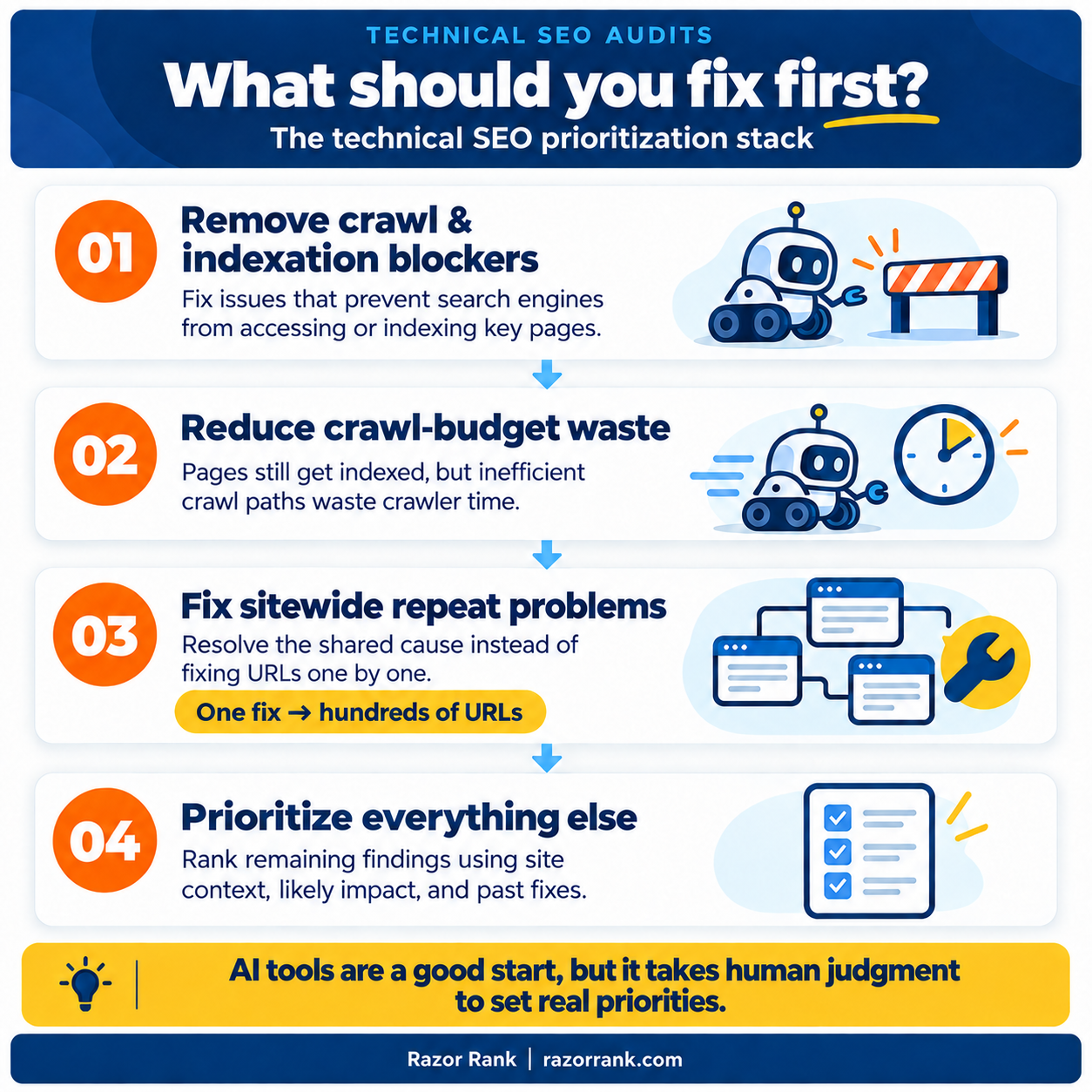
Once the full list of issues exists, deciding what to fix first should be based on expert judgment rather than the severity automatically listed by your tool of choice. Issues that block crawling or indexation outright come first: pages returning something other than a 200 status code, or blocked by a misconfigured robots.txt file, since everything else on the list depends on the page being retrievable in the first place. After that come issues that limit crawl budget even though the page still gets indexed. Sitewide, repetitive problems should also get addressed early, since fixing the systemic cause clears the largest share of the list at once and gives the crawler the biggest practical benefit for the least effort. A broken navigation template that creates the same redirect chain on every product page, for instance, is one fix that resolves hundreds of flagged URLs at once. Tools love to suggest severity, but deciding what actually moves the needle on this particular site, with its particular crawl budget and its particular history of what’s been tried before, requires knowledge from someone who understands why a problem exists in the first place.
AI SEO Audit Tools: What They Catch & What They Miss
AI-based tools are genuinely good at combing through large datasets inside a defined set of instructions. They can handle checking robots.txt directives or validating canonical tags across thousands of URLs reliably and fast, so you can save human hours on tasks like that. But AI tools are less reliable with verification, because AI systems tend to infer by default instead of confirming. Structured data is the clearest example. An AI-based check will often read part of a page and infer the rest of what’s marked up, while a full audit checks every page for every structured data type present, confirms each one validates against Google’s guidelines, and confirms it’s placed on the correct URL rather than assumed. Non-AI scanning tools have their own place in this too. Backlink toxicity scoring or domain reputation checks are good for scanners, which process volume well beyond what manual review could reasonably cover. You just need to understand whether a given check is inferring or verifying, and which layers need a human double-check on top of what the tool can do.
Auditing for AI Agents Plus Traditional Search Crawlers
What a technical SEO audit needs to cover keeps expanding in the age of AI crawlers. The newest addition is whether a site is legible to AI agents as well as search crawlers. Google’s own documentation on generative AI search now describes browser agents that access a site by reading its DOM structure, analyzing rendered screenshots, and interpreting the accessibility tree, much the way a screen reader would. That’s in addition to what traditional crawlers need, not a replacement, so remember to continue considering both. A site that an AI agent can navigate cleanly still needs working redirects and a clean crawl as parts of its foundation, since agents run into the same broken links and blocked pages a search crawler does. Auditing whether a site holds up to that kind of access is becoming as standard a check as robots.txt or canonical tags were a decade ago. A checklist from a few years back reflects the standards of when it was written, since AI search didn’t exist yet at the time. The real marker of whether an audit is current is whether the person running it is paying attention to who, or what, is actually visiting the site now. For a site owner, that means an audit you can trust should be able to speak to both: whether the site renders correctly for a browser, and whether it holds up under this newer kind of scrutiny too.
What to Look for in a Technical SEO Audit
A generated report can produce a checklist just as long as a real one, and sometimes longer. What a real person adds after that list exists is verifying it against the whole site, deciding what to fix first based on how this particular site actually behaves, catching the mistakes automated inference tends to make, and keeping pace with who’s reading the site as that keeps changing. That’s the work that happens after the checklist exists, and it’s what a client, or anyone reading an audit, should actually be checking for.
Razor Rank has a decade of experience running and acting on technical SEO audits for clients in diverse industries. If you think your latest audit is outdated or full of non-actionable steps, get in touch with us. We’ll give you a sanity check and recommend the technical priorities that are most likely to impact your bottom line.
Razor Rank is a full-service digital marketing agency specializing in SEO, paid media, CRO, and web. We help businesses grow through data-driven strategy and measurable results.