For years, digital advertising has run on two engines: Google and Meta. If you wanted to reach someone with intent to buy, you went to Google. If you wanted to reach them before they knew they wanted something, you went to Meta. That ecosystem worked, but it’s no longer the whole picture.
On May 5, 2026, OpenAI officially launched a self-serve Ads Manager for ChatGPT, opening the platform to U.S. businesses of all sizes with no minimum spend requirement. Regardless of your budget, you can now sign up, set spend limits, and start running ads. Here’s what the paid media team at Razor Rank has learned about OpenAI’s new ad platform, and how we think businesses should use it.
From “No Plans for Ads” to a Full Pilot
OpenAI’s launch of its open ads platform has moved incredibly quickly.
ChatGPT ads went live for US users on February 9, 2026, initially available only to enterprise advertisers willing to commit reported $200,000 minimums. Early participants included Target, Ford, and Adobe. Six weeks later, the platform had already crossed $100 million in annualized revenue. OpenAI then cut the entry threshold to $50,000 in April, announced international pilots in the UK, Mexico, Brazil, Japan, and South Korea, and by May 5 removed the minimum entirely.
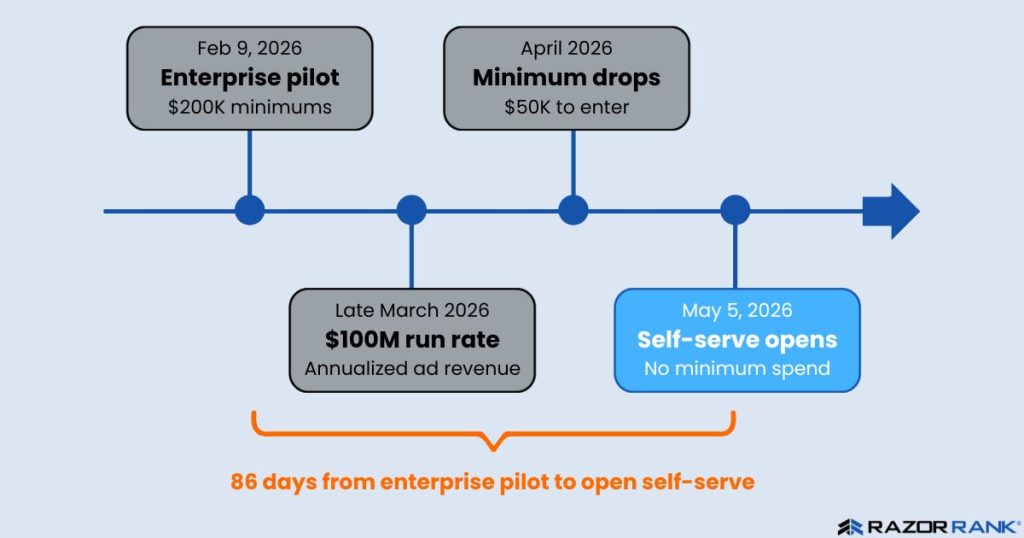
Google and Meta each took years to reach this point, while OpenAI went from an invite-only enterprise pilot to open self-serve within a single quarter.
What ChatGPT Ads Actually Are
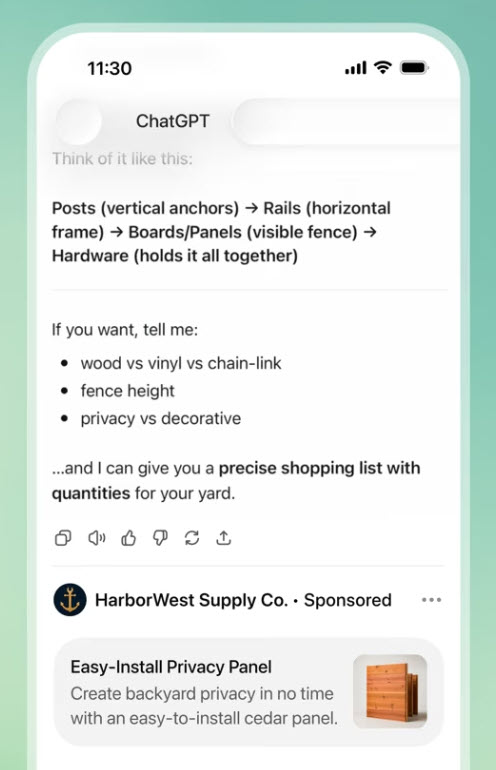
Ads on ChatGPT appear as clearly labeled, sponsored units at the bottom of AI responses. They don’t influence what ChatGPT says; the organic answer comes first, and a separate system evaluates ad relevance afterward. OpenAI has been explicit that the two systems should stay separate.
What makes these ads different from anything else on the market is the targeting model. Instead of using keywords or demographic segments as most ad platforms do, ChatGPT uses conversational context: what you’re actively discussing and what your chat history suggests about your intent. Someone asking detailed questions about a personal injury case sends a different audience signal from someone who visited a PI lawyer’s website once last month.
This makes a difference in terms of ad effectiveness because users on ChatGPT aren’t scrolling passively. They’re in problem-solving mode, comparing options and working toward a decision or conversion. Their level of intent is generally much higher, and they’re closer to the bottom of the funnel.
Are ChatGPT Ads a Strong Opportunity?
ChatGPT currently reaches about 900 million weekly active users worldwide and handles around 2.5 billion prompts per day. OpenAI is projecting $2.5 billion in ad revenue for 2026, which sounds modest against Google’s $295 billion or Meta’s $196 billion last year. But AI-driven search ads across the industry are projected to grow from roughly $2 billion in 2026 to $26 billion by 2029, moving from 1.3% to 13.6% of total U.S. search ad spend in just three years.
There’s also a practical advantage to being early to the platform. Advertisers who start now will benefit from lower costs per click and platform-specific performance data that competitors don’t have. They can also start learning what creative actually works in a conversational context before competition drives up the auction prices.
Is Advertising with OpenAI Right for Your Business?
ChatGPT ads aren’t a perfect fit for every category yet. The highest-value opportunities are in verticals where the buying decision is complex and requires research: professional services, education, financial services, B2B software, and higher-consideration e-commerce.
If your customers tend to ask detailed questions before they buy, and your business category involves a longer consideration stage, it’s probably worth testing the new ads. Local service businesses and highly regulated categories have more reason to wait. The platform is still in beta, and category restrictions haven’t been fully published.
We’ll add the caveat that because the platform is so new, no one has deep performance benchmarks yet, and that includes agencies. Cost estimates will be rough until campaigns start generating real spend data to compare against. In our experience with new ad platforms, it typically takes 30 to 60 days of live data before performance stabilizes enough to make confident budgeting decisions. As with any new advertising venture, we’d recommend starting with a test budget and realistic expectations instead of a mandate to hit a specific cost-per-lead in week one.
How Campaign Setup Works
The self-serve Ads Manager uses a three-level structure: campaign, ad group, and ad, which will feel familiar to anyone who has run Google or Meta campaigns. You select from a taxonomy of conversation topics to target (like “business software evaluation” or “personal finance decisions”), set a CPC or CPM bid, and submit for review before campaigns go live.
Current bidding defaults are a $60 CPM for Reach campaigns and $3 to $5 per click as a starting point for CPC campaigns. Cost-per-action bidding is arriving in early access this month. Custom audience uploads (hashed emails and phone numbers) are also in a gated rollout, which is just another sign that the platform’s infrastructure is maturing fast.
Campaigns run through a relevance-weighted second-price auction, so what you pay usually sits below your max bid.
Getting Started the Right Way
OpenAI requires each advertiser to register and verify their own account. That means account creation has to happen on the business side; an agency can’t create it for you. However, if you complete a simple registration at ads.openai.com, an agency partner like Razor Rank can be granted access to handle everything else.
The challenges we predict are defining which products or services make sense to advertise in a conversational environment, writing ad copy that fits ChatGPT’s compact format, setting sensible starting bids on a platform with no historical benchmarks, implementing conversion tracking so you’re measuring the value of your outcomes rather than just clicks, and adjusting campaigns during a critical first 30 to 60 days.
How Razor Rank Can Help
Our paid media team has been tracking the ChatGPT ads rollout since the pilot launched, and we’re already helping clients evaluate and adopt the platform. If you’re considering ChatGPT advertising, we can help you decide whether it’s a fit for your business right now, get your account set up correctly from day one, build and launch your first campaigns, implement conversion measurement, and manage the optimization process as performance data comes in.
If you’re interested in a straightforward conversation about whether ChatGPT ads would move the needle for your business, or how this fits alongside your current paid media and SEO strategy, contact us and we’ll walk you through it.
Razor Rank is a full-service digital marketing agency specializing in SEO, paid media, CRO, and web. We help businesses grow through data-driven strategy and measurable results.