If you run Local Services Ads, mark October 1, 2026 on your calendar. Google is redefining what counts as a “lead,” and the new definition will show up directly on your invoice.
Google emailed some LSA advertisers last week, from the Local Services Ads Team, to say that starting October 1, missed calls during business hours will be billed as valid leads if the caller stays on the line for more than 20 seconds. There has been no public announcement and no update to Google’s support documentation yet; the change surfaced because an advertiser posted a screenshot of the email on X. The tone of the official notice is mild, but this will actually be a fairly big shift. For as long as Local Services Ads have existed, an unanswered call has been the one outcome advertisers could count on not paying for. That’s no longer true, and the timing is awkward, too. It’s happening just as a lot of advertisers are still settling into Local Services Ads moving into the Google Ads interface, so a billing change is landing on accounts that were already in flux.
How LSA Lead Charges Work Right Now
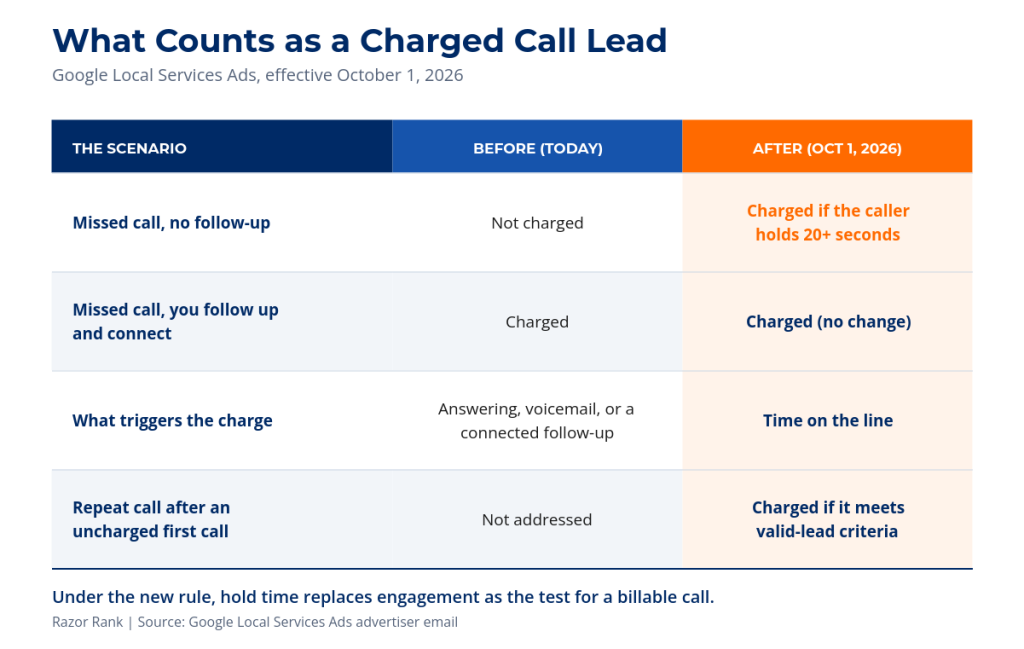
Under the current system, laid out in Google’s “How leads work” support article, a call only becomes a charged lead if there’s real engagement on your end. Google lists a handful of ways a valid lead gets generated: you answer and speak with the caller; the caller leaves a voicemail or uses an automated system to meaningfully engage with your business; you receive a text message or email from the customer; or, critically, if the call goes unanswered, your business follows up with a text, email, or return call that connects. The support page also lists lead types that won’t be credited even when charged, like leads received outside business hours or customers who don’t respond to a return call.
The advice circulating online claims that LSA already bills any unanswered call that rings past 30 seconds, but that isn’t in Google’s documentation. Every valid-lead trigger Google currently lists involves someone actually communicating. A missed call that just sits there, with no follow-up from you, has never generated a charge on its own.
Under that structure, the burden of “did this become a real interaction” was on the business, but it also meant a dropped call, a bad connection, or a busy front desk didn’t cost you anything unless you let the lead go cold entirely without any outreach.
The New Rule: 20 Seconds on the Line
Starting in October, the link between engagement and charge will break. Per the policy update Google sent advertisers last week, a call that rings through to your business during business hours and isn’t picked up will still be billed as a valid lead, as long as the caller stayed on the line past 20 seconds. Nobody from your team has to speak to them.
Google is also extending this to subsequent calls: If a first call doesn’t qualify as a charged lead, any follow-up call between that same customer and your business that meets the criteria will be charged, even when the original contact wasn’t billable.
In effect, hold time is replacing “did a conversation happen” as the trigger for billing.
Google’s Safeguards & Their Limitations
Google is building in two protections that are important for advertisers to understand.
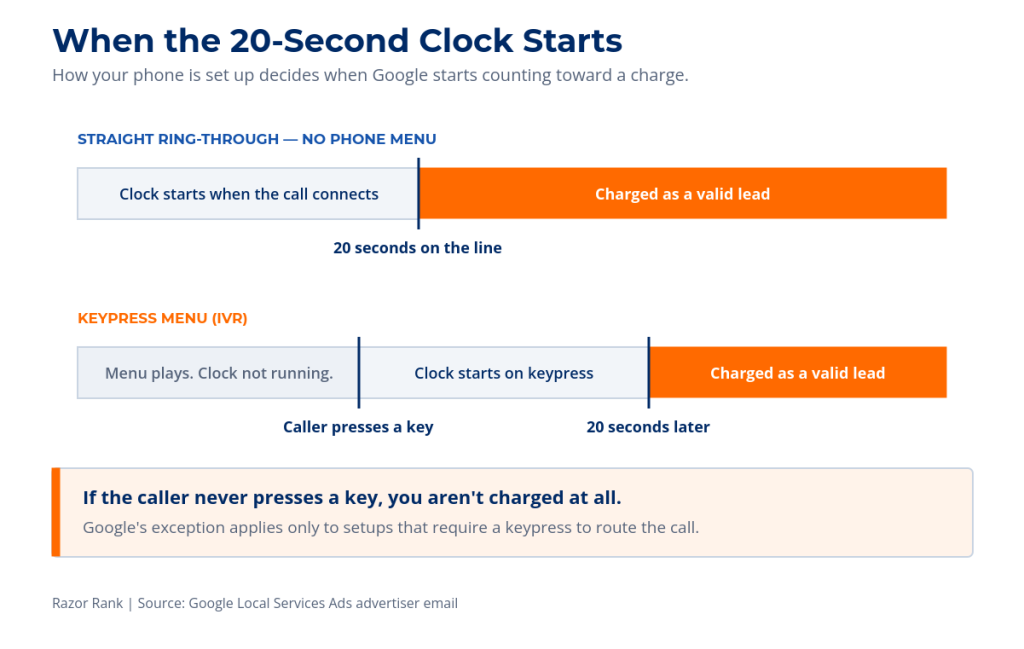
The keypress exception: If your call flow requires a caller to press a key to reach the right department, the 20-second timer doesn’t start until they press it. If the caller never presses a key to get routed, you won’t be charged at all, no matter how long they stayed on the line.
That means that a keypress menu could be a significant mitigation against getting charged. Callers who give up inside the menu, which may be a meaningful share of the people who would otherwise cross the 20-second threshold, simply never become billable.
The flip side is that businesses with a flat, no-menu setup have no equivalent protection. A call that rings and rings, with no menu to interact with, starts the clock immediately.
Spam and robocall filtering: Google says it’s introducing new safeguards to limit robocall and spam abuse. No specifics on detection thresholds or how disputes will work were included in the notice, so we recommend keeping an eye on potential spam calls once the change goes live. This is also the safeguard most likely to have gaps in its first few months.
Why Google Says This Rewards Responsiveness
Google’s stated rationale is that LSA users expect to reach a business quickly, and that the update “rewards businesses that provide excellent responsiveness.” That’s consistent with how Google has always talked about Local Services Ads: It’s a pay-per-lead product built on trust that the business on the other end will actually show up.
It also converts a call you dropped into billable inventory, and shifts the cost of your team’s response time directly onto your ad spend rather than just your close rate.
Both things can be true: The policy does create a real incentive to answer faster, but it also means the cost of not doing so is going up in a way it never has before.
What LSA Advertisers Should Do Before October 1, 2026
- Audit your answer rate now, while it’s still free data. Pull your call reporting and find out what share of LSA calls currently go unanswered during business hours. That number will soon become a cost line rather than just an operations metric, and it creates more of a difference between what a lead costs you and what a booked job costs you.
- If you don’t currently route calls through a keypress menu, price out adding one. A setup that requires callers to press a key both delays the 20-second clock and eliminates the charge entirely for anyone who hangs up before pressing. Weigh that against the friction a menu adds for callers who do want to reach you, but run the math carefully, because for a business with a meaningful missed-call rate, it may pay for itself in the first month.
- If you already use call routing, confirm it actually requires a keypress, not just a recorded greeting. Under the new rule, that distinction determines when the clock starts and whether the exception applies to you at all.
- Staff for your peak call windows, not your average volume. A single understaffed hour that generates a run of 20-second-plus missed calls is where this change will hit you the hardest.
- Watch your billing closely in the first few weeks after the October 1 rollout. Since the spam and robocall safeguards weren’t detailed, early false positives or edge cases are more likely to surface in your billing data than in Google’s announcement.
- Loop in whoever owns your phone system, not just whoever owns the ad account. This is as much an operations and staffing decision as it is a marketing one.
The bottom line: Google is replacing “did we talk to this person” with “did this person wait long enough” as the definition of a lead. For advertisers with tight call handling and a keypress menu already in place, this change might be a non-event. For anyone with gaps in coverage and a phone that rings straight through, it will be a direct hit to your cost per lead.
If you’re not certain what your LSA answer rate actually is, or whether your call routing qualifies for the keypress exception, those are quick things to check and expensive things to guess at. Razor Rank manages Local Services Ads for service businesses across a range of verticals, and we’re glad to look at your call data and routing setup before the deadline. You can read more about our PPC management services or contact our team for a second opinion.
Google LSA Missed-Call Policy: FAQs
The policy takes effect on October 1, 2026, according to the email Google sent to Local Services Ads advertisers.
Yes. If the call comes in during business hours and the caller stays on the line for more than 20 seconds, it will be billed as a valid lead, even if no one at your business answers or follows up.
Under Google’s current “How leads work” policy, a missed call only becomes a valid lead if your business follows up with a text, email, or return call that connects. Starting October 1, a missed call can be charged on its own, based on hold time, with no follow-up required.
No. If your call system requires callers to press a key to reach a department, the 20-second timer starts only after they press that key. Businesses without a keypress-based menu don’t get this delay.
You won’t be charged. Google’s exception states that you won’t be charged if customers don’t press a key to get routed, regardless of how long they stayed on the line. This applies only to call-receiving setups that require a keypress to route the call.
Yes. If an initial call doesn’t qualify as a charged lead, any subsequent call between that same customer and your business that meets the valid lead criteria will be charged, even though the first contact wasn’t billable.
Audit your current call answer rate, consider adding or confirming a keypress menu so the timer is delayed and non-routed callers aren’t billable, and staff for peak call volume rather than average volume, since unanswered calls during busy periods are the most likely source of new charges.
Razor Rank is a full-service digital marketing agency specializing in SEO, paid media, CRO, and web. We help businesses grow through data-driven strategy and measurable results.