If you haven’t already heard, Google is making a major change to the Local Services Ads (LSAs) platform that’s been reported widely across the search and tech press. In this post, we’ll tell you all the details that matter for Google advertisers and give our take on how this change is going to affect our clients and advertisers as a whole.
For as long as Local Services Ads have existed, they’ve been separate from the rest of Google’s ad ecosystem. They use a different dashboard, different login, and different reporting, putting LSAs onto their own little island next to Search, Shopping, and Performance Max. If you managed LSAs alongside other advertising campaigns, you’ve probably been used to working across two systems that didn’t do a great job of talking to each other. Google has now confirmed that’s ending.
Starting in August 2026, Local Services Ads are folding into the Google Ads interface, running as a new Performance Max campaign type built specifically for pay-per-lead, local service advertisers. The standalone LSA dashboard is going away, and everything you currently manage there moves into the same platform where your Search and Shopping campaigns already live. Lots of advertisers would argue that that’s where it should have lived the whole time.
What’s Changing in the LSA to Performance Max Migration?
Before anyone panics about their vetted, HomeAdvisor-style lead system turning into another mysterious PMax campaign, you should understand what this migration actually includes.
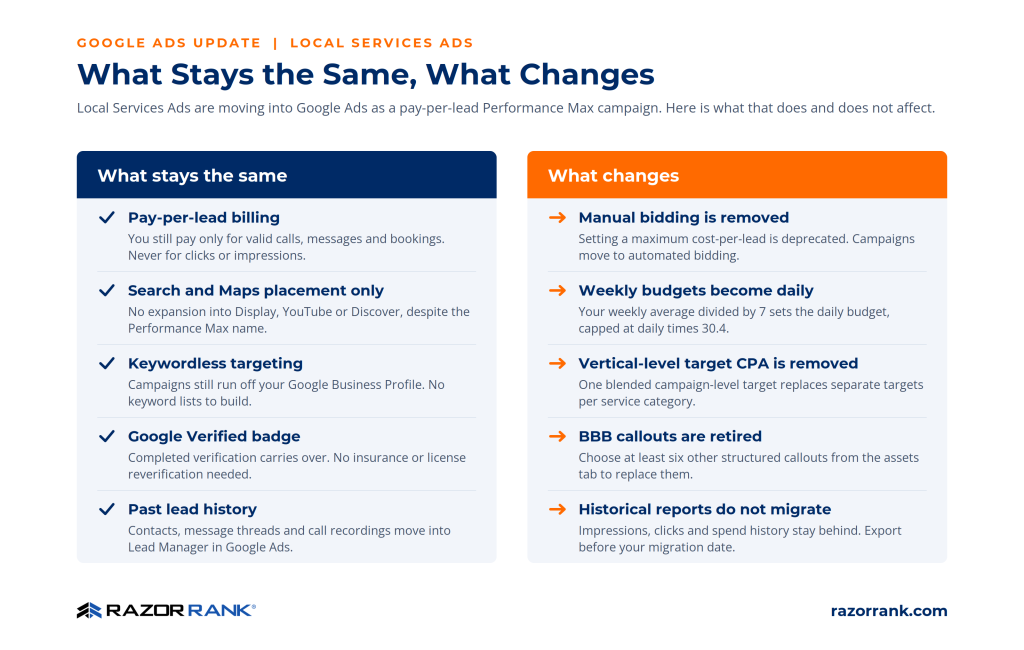
Google isn’t just merging LSAs into general Performance Max and letting the algorithm control what happens on the Display Network and YouTube. They’ve instead created a purpose-built campaign type that keeps the defining features of LSAs intact:
- Local Services Ads still only show on Search and Maps. There won’t be an expansion into Display, YouTube, or Discover, despite the Performance Max name attached to these campaigns.
- Campaigns stay keywordless, pulling from your Google Business Profile the same way they always have.
- You’ll still pay only for valid leads like calls, messages, and bookings. You won’t pay for clicks or impressions.
- Your Google Verified badge and completed business verification carry over automatically. Insurance and license reverification aren’t required.
What is changing is the wrapper around your LSAs. Advertisers will get one login instead of two, lead management that you can now find in the same place as the rest of your account, and real-time syncing so that any update to your Google Business Profile (new photos, changed hours, or updated service areas) pushes automatically into your campaign without a manual re-sync.
And let’s not forget that you’ll get access to more tools, optimization options, better account billing management, account access management, etc. No more random sections that break or won’t load or just decide not to appear anymore until you reload the page four or five times.
Why Google Is Folding LSAs into Google Ads
Google’s stated aim for this migration is “unified campaign management,” which we think is a fair description, but the change actually solves long-running problems for Google and advertisers.
LSAs have always been a lead-gen product that hangs out alongside Google Ads rather than something that’s built into it, which caused friction. Agencies had to manage budgets across two interfaces, GBP changes didn’t sync cleanly, and reporting was hard to line up with the rest of an account’s performance data. Folding LSAs into the core platform means Google can consolidate its ad products into one system it can improve as customer feedback comes in, and advertisers get more operational efficiency out of it too.
Google is talking about the migration as a change of address rather than a change of product, but there are a handful of important mechanical changes that come with this move.
What Changes: Bidding, Budgets, and Callouts
These are applied automatically on transition day:
Manual bidding is going away. If you’ve been setting a maximum cost-per-lead, that control no longer exists in Google Ads. Your campaign will move into a Target Cost-Per-Acquisition setting, which is a fully automated bidding strategy.
Target CPAs for specific verticals are going away too. If you’ve been running one LSA campaign with different target CPAs for each service category (for example, a higher target for roofing than for lawn care), Google collapses those into a single blended campaign-level target applied across every category. The only way to keep target CPAs separated by service line is to split them into different campaigns after migration. For multi-service home services clients, this is the change most likely to move cost-per-lead in the wrong direction.
Weekly budgets convert to daily budgets. Google will divide your historical average weekly budget by seven to set your new daily average, with monthly spend capped at that daily average times 30.4. Your monthly ceiling stays the same, but daily pacing will feel different, especially for anyone whose lead flow is seasonal or storm-driven.
BBB callouts are being retired. If you’ve used Better Business Bureau callouts as a trust signal within your ads, that asset is no longer supported. Google says to select at least six other structured callouts, like business hours, specialties, or accepted payment methods, from the campaign’s assets tab instead.
You can’t create new pay-per-lead campaigns in Google Ads yet. For now, new campaign setup still runs through the same web address: https://business.google.com/us/ad-solutions/local-service-ads/. Campaign creation within Google Ads will come later.
None of this changes the pay-per-lead model or where your ads appear, but it does change how you control ad spend. For anyone managing LSAs across multiple service categories, we recommend building a plan before your changeover notice arrives.
What to Do Before Your LSA Account Migrates
Here’s what to be aware of to help you build your pre-migration plan:
Export Your Historical LSA Reporting First
Google explicitly says that past performance reports are staying in the old LSA dashboard and won’t migrate with your account. Impressions, clicks, weekly spend, and ad-level performance won’t migrate to the new platform, and once your account moves, the old dashboard will redirect to Google Ads. That means you’re at risk of losing your historical data if you don’t export it now.
Your lead history will transfer, so customer contact details, message threads, and older call recordings will all go into the new Lead Manager inside Google Ads. But if you want to be able to reference year-over-year lead volume, cost-per-lead trends, or historical call data, export it now before your migration date comes.
You’ll Get 14 Days’ Notice, and That’s It
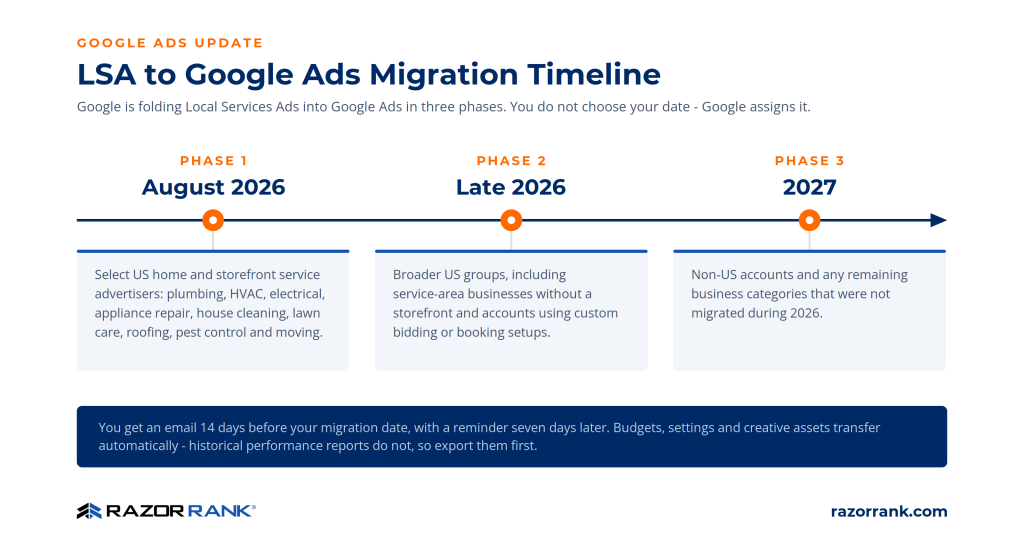
The account administrator on your profile will get an advance email 14 days before the migration date, a warning banner inside the LSA dashboard, and a follow-up reminder email seven days after the first one. Google picks the date of your migration. Two weeks is enough time to pull reports as long as your administrator is watching for the email, but it’s not nearly enough if that email goes to an inbox that nobody checks. Make sure the administrator on the account is someone who will act on it.
The Rollout Is Phased by Vertical and Isn’t Universal
Phase one begins in August 2026 with select home and storefront service advertisers in the US, like plumbing, HVAC, electrical, appliance repair, house cleaning, lawn care, roofing, pest control, and moving. In late 2026, the migration will expand to service-area businesses without physical storefronts and accounts with custom bidding and booking. In 2027, non-US accounts and any remaining categories will switch over. If you manage any LSAs in the phase-one verticals, you should expect a migration notice very soon.
Budgets, Settings, and Creative Assets Transfer Automatically
This should be the easiest part of your transition. Targeted locations, service types, business categories, budget limits, ad schedule, and business photos all move over without you having to do anything manually. Google is asking advertisers to allow up to two weeks after their migrations for performance to get back to stable levels, so it’s good to have your expectations set appropriately. Because the reports coming out of Google Ads will be different, make sure your reporting and lead reviews are attached to the new interface instead of the old standalone LSA dashboard. Lead Manager now lives under Goals › Conversions › Leads, and the metrics you’ll probably care most about are Conversions (charged leads), Cost, and Cost / conv. (your cost per lead).
Local Services Ads Migration FAQs
Phase one starts in August 2026 for select US home and storefront service advertisers. Broader U.S. groups migrate in late 2026, and non-US accounts and remaining categories will change over in 2027. You’ll receive an email 14 days before your specific migration date.
Yes. Past lead history, including contact details, message threads, and call recordings, moves into Lead Manager in Google Ads. Completed business verification and your Google Verified badge carry over as well. Historical performance reports do not transfer.
No. You still pay only for valid leads such as calls, messages, and bookings, not for clicks or impressions. Ads continue to serve only on Google Search and Google Maps.
For now, yes, but not inside Google Ads. New pay-per-lead campaign creation will still happen at https://business.google.com/us/ad-solutions/local-service-ads/. Google has said that campaign creation inside Google Ads will become available later.
What the LSA Migration Means for Your Lead Flow
Google’s objective with this migration is to consolidate their advertising products. If your LSA campaigns are performing well today, you’ll still have the same eligibility, pay-per-lead model, and placements within Search and Maps.
In our opinion, the loss of manual bidding and ability to target CPAs by vertical are the most important things to keep in mind. These will change how you control ad spend and are critical concerns for multi-service advertisers. Make sure your historical data is exported before the migration, decide whether your service categories need to be split into separate campaigns to maintain their cost-per-lead, update your internal reporting to reflect the single-platform metrics visibility, and make sure whoever manages your Google Business Profile knows that GBP is now more closely connected to your ad spend than it used to be. If you run Local Services Ads and want help getting ahead of the migration, from exporting historical data to auditing your Google Business Profile before it starts syncing live, Razor Rank can help. When you reach out, we’ll take a look at your current LSA setup and build a plan for the transition.
Razor Rank is a full-service digital marketing agency specializing in SEO, paid media, CRO, and web. We help businesses grow through data-driven strategy and measurable results.