For the last two years or so, most SEOs have lived with the same AI-based frustration. We watched organic traffic decline as AI Overviews answered more and more questions directly in the SERPs, but Google gave us no way to measure what was happening inside those answers. There was a shift in everyone’s metrics, but nothing trackable to explain it.
That started to change on June 3, 2026, when Google added Search Generative AI performance reports to Search Console. Now, you can see your site’s visibility inside Google’s AI features as its own line item. It’s definitely an improvement over the total lack of from-the-horse’s-mouth clarity we had before. As we often see with first releases, though, the new report answers one important question and leaves an even more important one open.
What can you see in the Search Generative AI report?
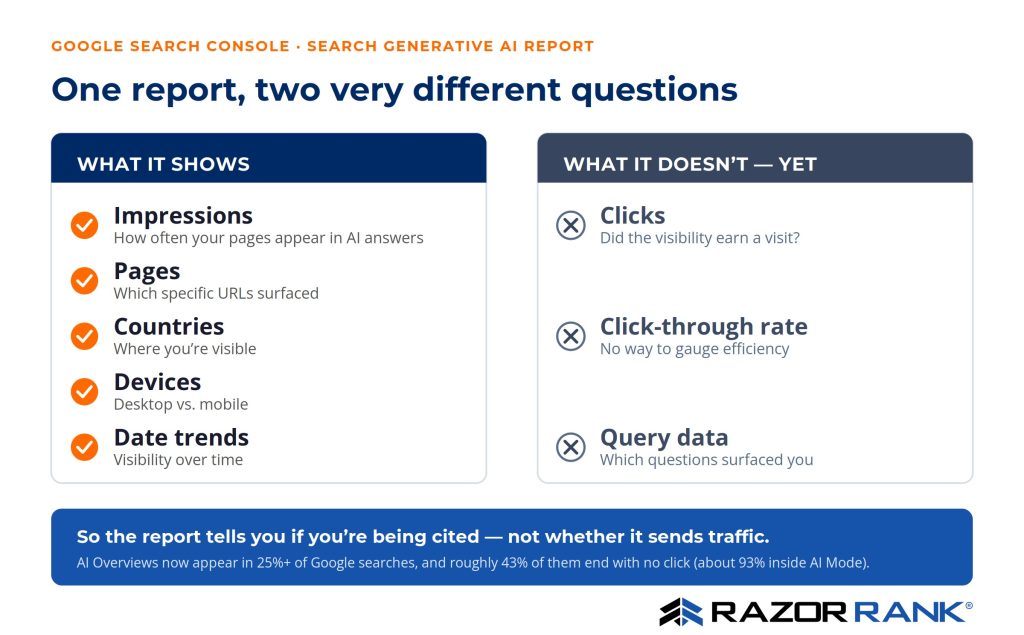
The new reports give you a view of how often your pages appear inside Google’s own generative AI responses (AI Overviews and AI Mode), plus generative features in Discover. Google Seach Console used to bundle that data with your overall performance data, which made it impossible to separate AI visibility from traditional organic visibility. Important: The GSC report does not offer any visibility data for other AI tools like ChatGPT, Gemini, or Perplexity.
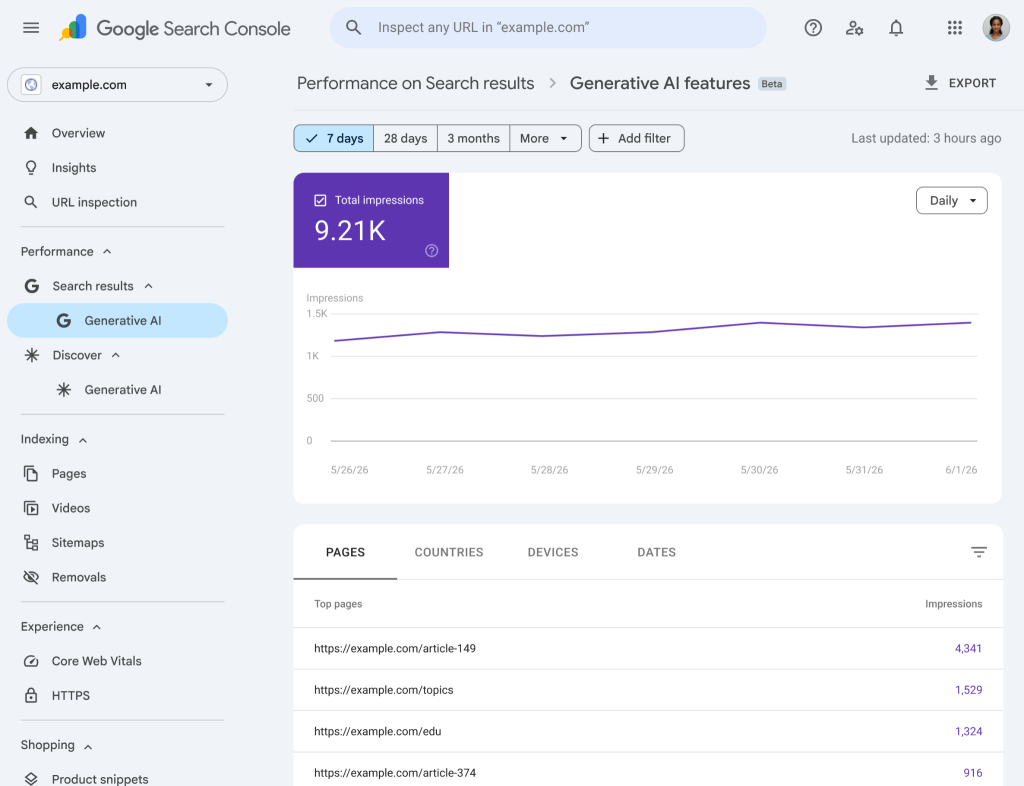
The new performance report shows impressions (how often your URLs showed up in AI features), the specific pages that appeared, the countries where you were visible, the device types, and how those trend over time. As you can see in the screenshot below, the graphs look very similar to what you’re already used to seeing in the Performance report. If you’re in the US, you’ll have to wait to see these for a while. Google is rolling Search Generative AI performance out to a subset of UK sites first, and they haven’t announced a date for the global rollout yet. For context, Bing has offered similar AI data since earlier this year, so Google is clearly trying to compete with their rollout.
The UK version of the release also comes with a control that lets you decide whether your content can appear in Google’s AI features. By default, your site’s content will be included, and if you do opt out, GSC won’t show you these new reports. Google began honoring that setting on June 17, 2026. For most businesses, it’s probably best to stick with the default, but at least you’re offered a conscious choice. This is similar to the controls that Cloudflare began offering to its users earlier this year.
Search Generative AI performance shows impressions, but not clicks
There’s a really important limitation to be aware of in the new GSC report: It only shows impressions. For now at least, you won’t be able to track clicks, click-through rates, or query data.
In other words, the report answers a question a lot of our clients are asking: Are we showing up in AI answers? It doesn’t let you know whether that visibility is sending any actual traffic to your site. Those are two very different questions, and while one focuses on what is mostly a vanity metric (search appearance), the other (clicks) is actually tied to your bottom line.
Why do AI clicks matter more than impressions?
To understand why impression data alone is so lacking, look at how much of search now happens inside an AI answer. AI Overviews appear in more than a quarter of all Google searches, up from roughly 13% just a year ago. The whole point of an AI answer is to resolve the user’s question right there on the SERP, which means a huge and growing share of those searches end without anyone clicking through to a source.
As most SEOs are painfully aware, the metrics we care about most are both hurt and hidden by this fact. Recent analyses have shown that somewhere between 43% and 83% of AI Overview searches end without a click. This is true of about 93% of AI Mode searches, where the interface is even more purposefully designed to keep the user inside the conversation rather than sending them to another source. Zero-click research has pointed in the same direction for years, with well over half of US searches ending without a click even before AI features entered the chat.
Being cited is the new “position one”
For a long time, our goal was to rank in the top handful of blue links and earn a click. Now, when an AI answer pulls sources together and cites them, being one of those cited sources is its own form of top placement.
In order to really report on success or progress in AI search, you now need two scoreboards instead of one. Classic performance (clicks, rankings, and conversions) is still huge, especially for commercial pages where you absolutely have to earn the click to see any return. But AI visibility (impressions and citations) is becoming its own measure of whether your expertise is reaching people at the moment they’re forming an opinion, usually before they ever land on your site. You can now see yourself “winning” in AI answers even while your bottom-line metrics stay flat. Being named and quoted in an AI answer is what most clients now see as the “win” even if it doesn’t drive any clicks, because the impression alone does build brand visibility and trustworthiness.
The current state of AI search visibility forces us to be satisfied with a more minor win now that we’ve gotten used to the drop in click-throughs, and this report is the first Google tool that lets you at least report on that version of success.
How to use the Search Generative AI performance report
The report is useful the day you get access, even in this impressions-only form. Here’s how to put it to work:
- Create a baseline for AI visibility. Pull your current AI impressions and learn which pages are earning them. You can’t tell whether you’re gaining or losing ground without a starting point, and the sooner you set one, the more useful your trendline will be.
- Find gaps between traditional organic and AI visibility. In early testing, one pattern shows up repeatedly: A handful of in-depth guide pages drive the majority of a site’s AI impressions, while core service pages that rank perfectly well in traditional search hardly appear in AI answers at all. You can create a priority list of pages that clearly deserve to be cited but aren’t yet.
- Strengthen the signals AI systems look for. Pages that get quoted tend to offer clear, direct answers near the top of the page, question-led headings, EEAT signals like genuine expertise and first-hand experience (real authors, specifics, proof of knowledge), and freshness. Cited content can start earning AI impressions within days of publishing, but that tapers off when the content gets stale, so you need to make sure you’re revisiting and updating your best pages.
- Use formatting to your advantage. Structured, comparison-style content earns a disproportionate share of AI citations because it’s the easiest for LLM bots to read and parse. One analysis found that listicles make up 40–65% of the most-cited URLs, depending on the AI model, much more than standard product or article pages tend to earn. Well-written comparison and “best X for Y” content performs well. That doesn’t mean you should rework all of your content into listicles, or that you should neglect the product and service pages that actually convert. Experimentation is probably the smart way to go, especially since Google’s recent but unconfirmed “7-Eleven update” seems to be targeting self-serving listicle content.
- Report on metrics separately. When you share results with your team or your clients, keep AI visibility and traffic in separate columns. Presenting an impressions gain like it’s a traffic gain, or treating flat traffic as failure when your AI visibility is growing, can lead to the wrong decisions. Non-SEOs will need to understand the difference and the importance of both metrics.
The bottom line
Google’s new report doesn’t tell you everything. It does a good job of showing visibility metrics, not traffic, and the click data everyone wants isn’t here yet. But this is the first time Google has let you see inside the AI answers that are changing how you get found on the internet. Even though we’re only seeing incomplete data for now, you can use the Search Generative AI report to start baselining, understanding which pages rank and which ones get cited and adjusting content where necessary, and getting comfortable measuring visibility and traffic as two separate things. Just working those three tactics into your reporting strategy will give you a significant leg up on businesses that wait for more robust reports to roll out.
If you need help setting baselines or understanding what your own report is telling you, Razor Rank is here for you. Contact us for an audit of your current reporting setup, help adjusting your content formats for AI visibility, and adding in vital EEAT signals across your site.
Razor Rank is a full-service digital marketing agency specializing in SEO, paid media, CRO, and web. We help businesses grow through data-driven strategy and measurable results.