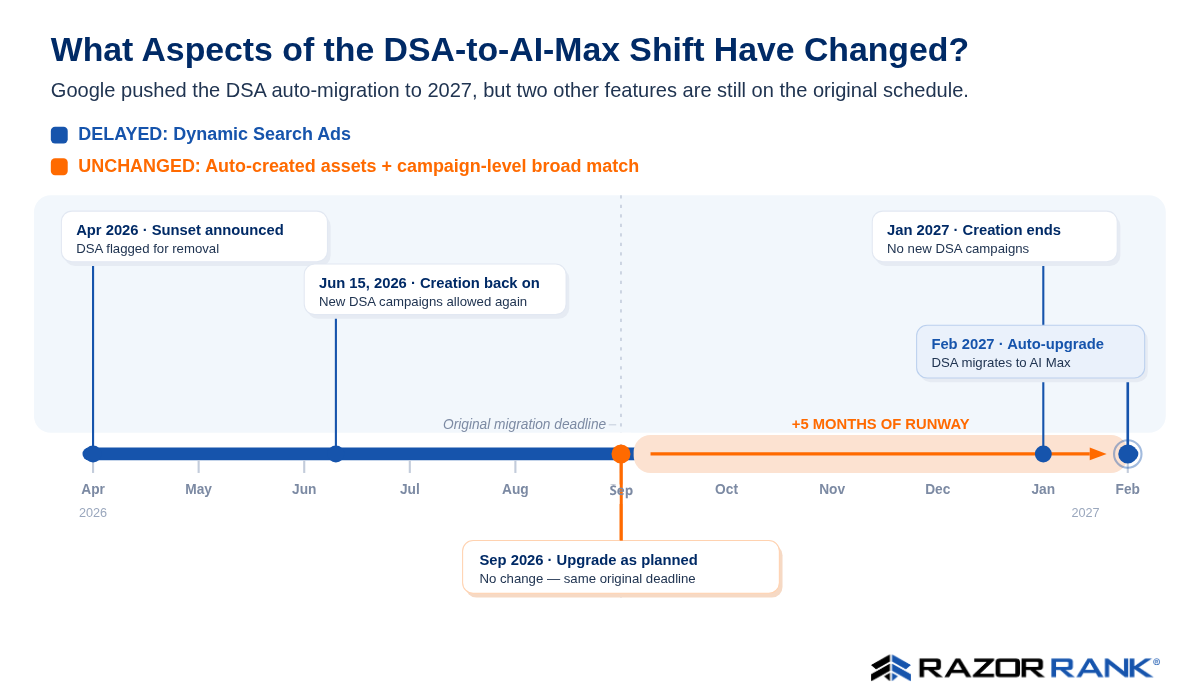
In April 2026, Google made the announcement that Dynamic Search Ads were on the way out. Starting in September, DSA campaigns, along with automatically created assets and the campaign-level broad match setting, would be automatically upgraded to AI Max, Google’s bundle of AI features for Search. PPC experts and practitioners immediately started recommending urgent action. The message was firm and the date was set, so the agency world did what it usually does: We saw a wave of “act now before September” posts and started prepping clients for the switch.
Then, on June 11, Google moved the date.
The DSA automatic upgrade is now pushed to February 2027, a five-month extension. The ability to create brand-new DSA campaigns, which had been slated to disappear, was switched back on as of June 15. New DSA creation will now go away in January 2027, with auto-migration following in February. The reason Google gave, by way of Ads Liaison Ginny Marvin, was that advertisers asked for more time and the company didn’t want to disrupt anyone’s Q4. So the deadline moved because enough people pushed back. But before anyone exhales too hard, it’s important to be precise about what actually got delayed. Automatically created assets and the campaign-level broad match setting are still being upgraded to AI Max on the original September 2026 schedule. The reprieve applies only to DSA. If your accounts lean on ACA or campaign-level broad match, your timeline hasn’t changed at all.
A Quick Refresher on AI Max
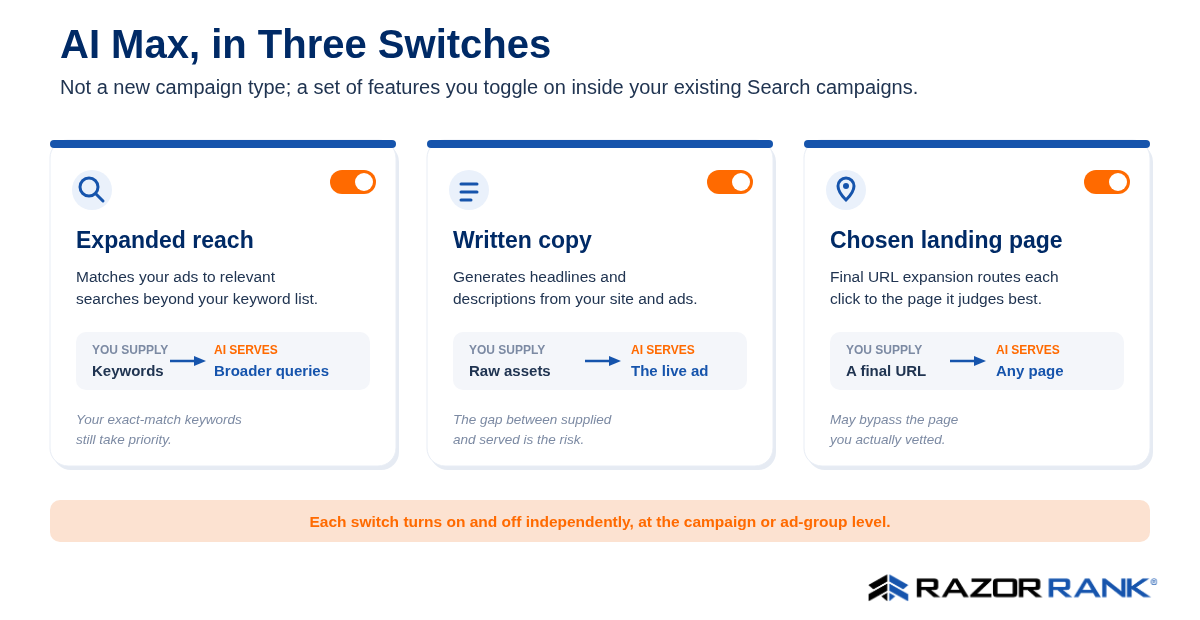
Some of the panic in April came from people thinking they’d have to rebuild their accounts from scratch, and that was never the case. AI Max isn’t a new campaign type; it’s a set of AI features you switch on inside your existing Search campaigns, and it does three main things.
It expands your reach by matching your ads to searches beyond your keyword list, though your exact-match keywords still take priority, which is the part people most often miss. It writes ad copy for you, generating headlines and descriptions pulled from your site and your existing ads. And it picks landing pages, using final URL expansion to send each click to whatever page on your site it judges most relevant, rather than the one you hard-coded.
More reach, automatically written copy, automatically chosen landing pages. You can toggle each of these on or off, which matters more than it might sound like, and we’ll come back to it.
What the DSA Delay Probably Means
Google framed the extension as a response to advertiser feedback, and that’s plausible at first glance. The Q4 concern is real, since nobody wants a forced migration in the middle of their biggest revenue quarter, and giving people room is reasonable.
But what does the timing imply? A company doesn’t hand back five months on a flagship rollout it had firmly scheduled unless the transition was rougher in practice than the launch messaging suggested. It’s not that damning, and it’s pretty normal for a change of this magnitude. Automated features that change how Search campaigns match queries, write copy, and route traffic need more real-world testing than a beta and a blog post can provide. This is a bigger and messier change than “flip a switch and get more conversions,” and the delay is a reason to approach it deliberately rather than to write the product off.
How to Use the Extra DSA Runway
If you’re reading the delay as “great, I can ignore this until next year,” I’d recommend rethinking that. You can ignore it, but then you’re the one making rushed decisions in January when the runway runs out.
Until June, this transition was being compressed into a handful of months. Now there’s much more time between today and the February 2027 cutoff, and you can use it as an opportunity. It’s room to test AI Max against your current setup, see how it behaves on your own accounts with your own budgets and clients, and migrate on a schedule you control instead of one Google sets for you. The advertisers most likely to get into trouble are the ones who treat the runway as permission to stop thinking about it, and then end up struggling under a deadline regardless.
Regulated Industries Should Start Testing Early
The extra months help everyone, but they don’t remove an important underlying concern for certain advertisers, and that’s the part most news coverage glosses over.
AI Max is designed to chase opportunity rather than to enforce compliance rules, which for most advertisers won’t matter much. The worst case is some wasted spend on off-target queries, which you catch and prune. In a regulated space, though, the same behavior can be risky. Healthcare is the clearest example, and you shouldn’t skip this part even if you don’t work in that industry. My logic here extends to anyone who has to choose their messaging carefully in order to stay both legal and trustworthy.
Starting with the copy: In a healthcare account, every headline and description is a regulated surface, governed by HIPAA, FTC truth-in-advertising rules, and platform policy. Now consider how AI Max works: You supply the raw assets, but Google’s AI assembles the live ad that a patient actually sees. That gap between what you supplied and what gets served is where the problems can come in. Auto-generated copy can drift into implied medical claims or language that a compliance team would never have signed off on, and there’s nobody to approve specific ad copy and combinations.
Final URL expansion can make things worse. A healthcare advertiser builds specific landing pages for specific audiences, often with consent language and privacy considerations baked in. If you let AI Max route clicks freely, it can send someone to whatever page it sees as relevant, bypassing the one you vetted. Query expansion works the same way: The feature that helps a retailer discover profitable new searches can surface a sensitive-vertical ad against queries you would never have chosen to appear on.
None of this means a regulated advertiser can’t use AI Max; it just means they can’t use it on autopilot, and they should be the most deliberate about testing it before anything becomes mandatory.
Test Now, Upgrade Later
My actual advice isn’t “rush to upgrade.” Most of the posts out there say that early adoption is a way to stay ahead, and I don’t buy that as blanket guidance. Upgrading early just opts you into less-tested automation sooner, with no easy way back. The extra months are there to be used for testing, not for avoidance and not for eager surrender either.
Google Ads has a built-in AI Max experiment that can help you “try before you buy,” so to speak, within an account. It splits traffic and budget within a single existing campaign, running a control arm with the features off against a trial arm with them on. You get a real, side-by-side read on how AI Max performs on your account, rather than a case study from someone else’s, without committing the whole campaign to it. Run that, and watch the search-term report closely to see what new queries the expansion is matching you to. If a feature misbehaves, turn it off; you can disable final URL expansion or text customization at the campaign or ad-group level without abandoning the rest.
Then decide your next steps based on your own data, not any deadline, a vendor’s headline conversion stat, or a competitor’s blog. If your experiments show AI Max lifting performance on a straightforward account, let it run, and you don’t even need to wait for the auto-upgrade. If it shows drift that should worry a regulated advertiser, then you have until February to build the guardrails or decide it’s not the right fit.
That’s what the extra time is really for. Google gave the market more room to smooth out the transition, and the advertisers who come out ahead will be the ones who used it to replace guesses with evidence.
If you’re ready to start testing AI Max campaigns for your business, Razor Rank can help. Get in touch with us for an overview of your current performance and actionable recommendations on how to maximize your use of these new tools.
Razor Rank is a full-service digital marketing agency specializing in SEO, paid media, CRO, and web. We help businesses grow through data-driven strategy and measurable results.