In order to rank highly in organic search, law firm websites need most of the same optimizations that are standard in SEO: a complete and accurate Google Business Profile, deep and credible practice area content, authoritative backlinks, strong client reviews, and a fast, clean technical foundation. Firms that manage these factors already have a leg up on many of their competitors. But as we move into the future of search, sites that keep up with changing user and search engine behavior by including modern signals like brand recognition, how quickly your pages satisfy a searcher, and whether AI assistants cite your firm will perform even better and be future-proofed against Google’s evolving algorithm. This guide covers both: the fundamentals every firm needs plus the modern factors that separate the firms dominating their markets in 2026 from the ones stuck on page two of the search results.
Key Takeaways
- Your Google Business Profile is the highest-impact factor in local legal search, and most firms leave theirs half-finished.
- Content depth and credibility are vital. Thin, attorney-free practice area pages don’t rank for high-stakes legal queries.
- Authoritative backlinks give you a “thumbs up” from the larger internet. Relevance and source quality matter far more than volume.
- Newer differentiators like brand demand, click satisfaction, and AI-search visibility are where competitive firms need to invest today.
The Rules Are Different for Legal SEO
There are three major factors that make legal SEO its own discipline, and set agencies like Razor Rank apart from “traditional search-only” partners. Google treats legal content as “Your Money or Your Life” (YMYL) information just like medical and financial advice. Search engines hold YMYL sites to a higher standard of Experience, Expertise, Authoritativeness, and Trustworthiness (what SEOs call EEAT). Most legal searches also come with strong local intent and urgency, because someone searching for “car accident lawyer near me” needs help now, in their city. Bar advertising rules also govern what claims you’re allowed to make online, so results and testimonials have to be handled carefully. Together, those forces change which factors matter most for legal sites and how aggressively you should approach them.
Part 1: Foundational Legal Ranking Factors
These are the signals that move the needle most for law firm websites, in order of impact. If you’re deciding where to spend limited time and budget, start at the top.
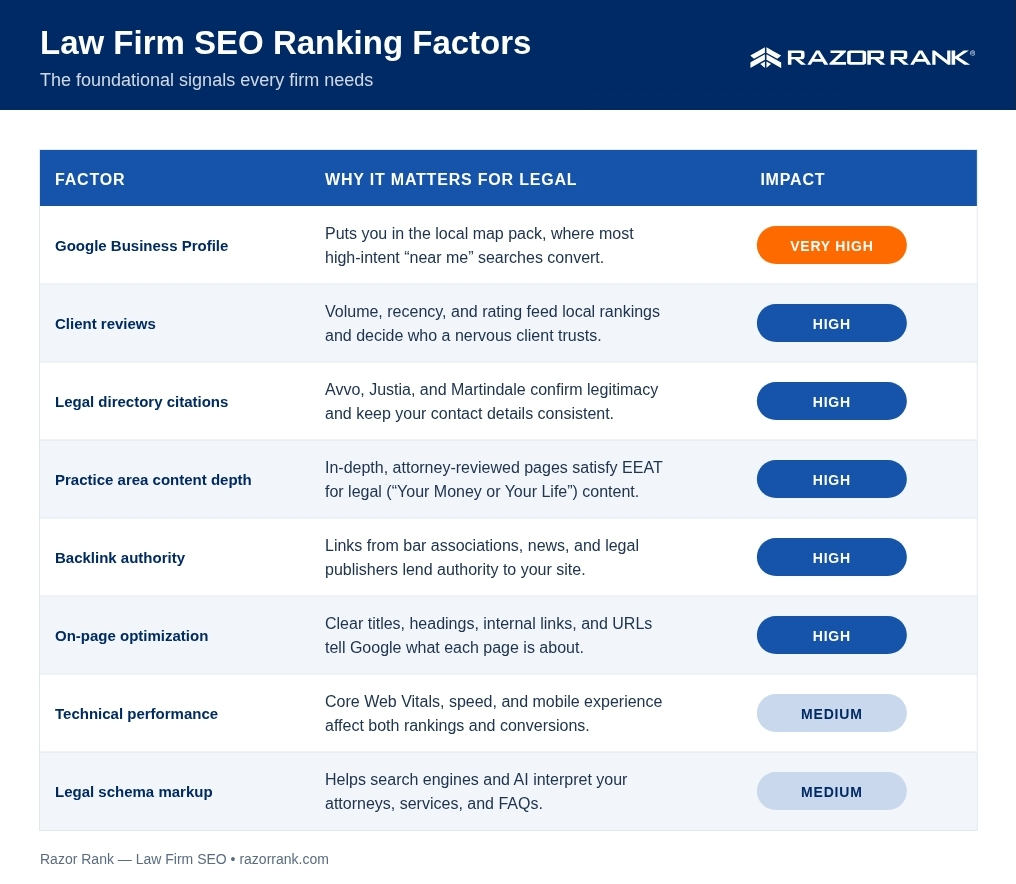
| Factor | Why it matters for legal | Impact |
| Google Business Profile | Puts you in the local map pack, where most high-intent “near me” searches convert. | Very High |
| Client reviews | Volume, recency, and rating feed local rankings and decide who clients trust. | High |
| Legal directory citations | Avvo, Justia, and Martindale confirm legitimacy and keep your contact details consistent. | High |
| Practice area content depth | In-depth, attorney-reviewed pages satisfy EEAT for legal (“Your Money or Your Life”) content. | High |
| Backlink authority | Links from bar associations, news, and legal publishers lend authority to your site. | High |
| On-page optimization | Clear titles, headings, internal links, and URLs tell Google what each page is about. | High |
| Technical performance | Core Web Vitals, speed, and mobile experience affect both rankings and conversions. | Medium |
| Legal schema markup | Helps search engines and AI interpret your attorneys, services, and FAQs. | Medium |
Google Business Profile (Very High)
Your Google Business Profile is the most important aspect of local legal search. It feeds the “map pack” (the block of three firms shown with a map above the regular results), and that’s where most high-intent “near me” searches turn into phone calls. A complete, active profile can outperform a much larger firm’s website in its own city.
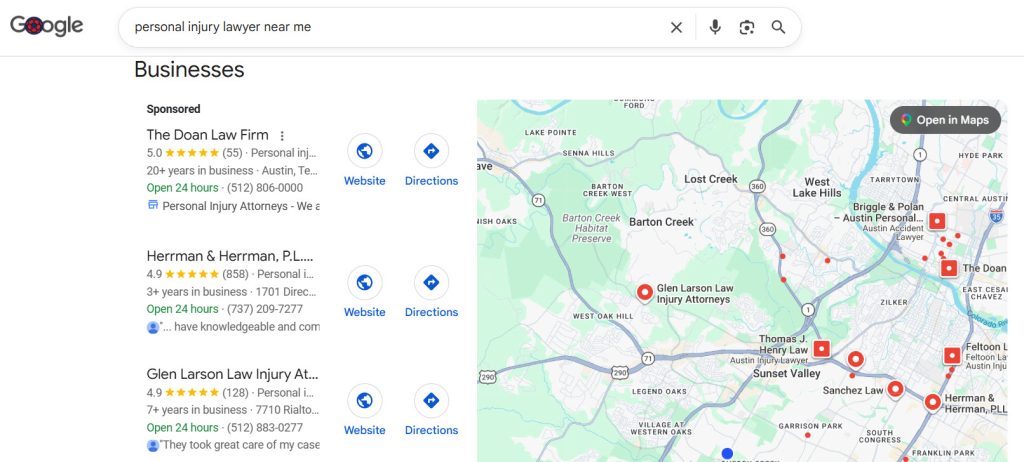
What to look out for: Claim and verify your Google Business Profile, and choose the most specific primary category for your firm, like “Personal Injury Attorney,” rather than “Lawyer.” Keep your name, address, and phone number identical everywhere they appear online. Post updates regularly, include the services your firm provides, add real photos, add to the Q&A section with common questions, and respond to every review. Each office needs its own profile tied to a real, staffed address.
Client Reviews (High)
Reviews are both a direct local ranking factor (volume, recency, and ratings all feed into where you land in the map pack) and one of the most persuasive trust signals a prospective client thinks about before calling you. For a high-stakes decision like hiring a lawyer, a wall of recent, specific reviews can be more powerful than any content you add to your site.
What to look out for: Build a simple, repeatable way to ask satisfied clients for reviews, within your state bar’s rules. It’s important to earn a steady volume of reviews over time rather than a one-time burst, and you should respond to reviews, even critical ones, professionally and without disclosing confidential details.
Legal Directory Citations (High)
Citations are mentions of your firm’s name, address, and phone number on other sites, especially the legal directories that clients and search engines already trust, like Avvo, Justia, FindLaw, and Martindale-Hubbell. Consistency tells Google it can confidently send people to the right place, and a presence on established directories signals you’re a real, practicing firm.
What to look out for: Claim your profiles on the major legal directories, fill them out completely, and make sure they don’t feature old addresses or outdated phone numbers. Inconsistent listings can drag down local rankings.
Practice Area Content Depth (High)
This is where EEAT comes in. A thin, three-paragraph page on “Personal Injury” won’t tell your prospective clients or Google much about your firm. A thorough page that explains your unique intake process, answers the questions clients actually ask, addresses what a case is worth and how long it takes, and is reviewed by a licensed attorney signals your expertise and gives AI systems something substantial to cite.
What to look out for: Give every practice area its own dedicated, in-depth page written in plain language, not legalese. Cover the real questions clients ask before they sign, show the experience behind the answers, and have an attorney review it. If you have location-specific pages, don’t just copy the same content from page to page with only the city name swapped out. Adding in differentiating details to those pages is increasingly important, so make sure each one’s content is localized to the geographic area it covers.
Backlink Authority (High)
Backlinks, which are links to your site from other websites, remain one of the strongest signals of trust and relevance, and they carry extra weight in YMYL categories like legal. A link from a bar association, a respected legal publication, a university, or a local news outlet tells Google that credible sources have given you the digital “thumbs up.” Quality is much more important than quantity. A handful of authoritative links usually outperforms hundreds of low-value ones.
What to look out for: Earn links through genuinely useful content, digital PR, bar and association memberships, sponsorships, and legitimate legal directories. Stay far away from paid link schemes and private blog networks, which can trigger search engine penalties that are slow and costly to recover from.
On-Page Optimization (High)
On-page optimization is how you tell Google what each page is about through title tags, headings, internal links, and simple, human-readable URLs. On-page optimization by itself won’t make a weak page rank in search results, but neglecting it can easily keep you off of page one. This is the most basic and table-stakes factor in SEO, but most law firms still take half measures when it comes to the basics.
What to look out for: Write descriptive title tags under about 60 characters that lead with the practice area and city (“Personal Injury Lawyer in Austin, TX — Free Consultation” is better than “Welcome to Our Firm”). Use heading hierarchy to structure each page logically, keep URLs short and readable (/car-accident-lawyer-austin/), and link related pages to each other so authority and crawler bots can move easily through your site. Meta descriptions aren’t a direct ranking factor, but compelling ones are more like to make prospects click your results.
Technical Performance (Medium)
Technical performance covers how fast your site loads, how stable it is as it loads, and how well it works on a phone, measured partly through Google’s Core Web Vitals. Like on-page optimization, technical SEO rarely earns you a top spot by itself, but poor performance actively costs you rankings and any visitor who gives up before a slow page loads. Since most legal searches happen on mobile, often urgently, it matters more for you than it does in other industries.
What to look out for: Aim for the Core Web Vitals thresholds that Google considers “good” — Largest Contentful Paint under 2.5 seconds, Interaction to Next Paint under 200ms, and minimal Cumulative Layout Shift. Prioritize mobile speed, keep your site architecture clean and crawlable, and make your phone number a tap-to-call link. Experienced SEOs treat technical health as the foundation that everything else sits on.
Legal Schema Markup (Medium)
Schema markup is structured code that spells out who your attorneys are, what you practice, where you operate, and what your FAQs say, and it presents that information in a format search engines and AI models can read while crawling. It doesn’t change what visitors see, but it helps search engines interpret your site accurately and makes your content easier for AI assistants to lift and cite correctly.
What to look out for: Implement relevant schema like LegalService, Attorney, FAQ, and Review markup where appropriate, and keep it accurate. As more searches happen via AI Overviews and LLM assistants like ChatGPT, clean markup can be a huge advantage. You can test your schema markup’s functionality with schema.org’s free structured data testing tool.
Part 2: Modern Legal Ranking Factors
The factors above are the ones you’ll find in every competent rankings guide. But the firms pulling ahead in the current search landscape are also conscious of a newer set of signals, which both overlap with and amplify the fundamentals. These considerations will set you apart from firms that are still living in the SEO stone age, and they’ll help you future-proof your site against Google’s persistent algorithm changes.
1. Brand Search Demand
When people search for your firm by name, Google reads that as a vote of confidence. Branded searches are evidence that you’re a known, trusted entity rather than an anonymous site. What SEOs have long suspected about how Google treats brand and navigational queries was reinforced by the 2024 leak of its internal Search documentation and by testimony in the U.S. antitrust case against Google. We now have proof that building brand recognition across the web is a must. You can increase your firm’s brand awareness by earning press mentions, pursuing legitimate “best [practice area] lawyer in [city]” placements, publishing content that’s worth sharing, and staying visible on other search platforms that people actually use, like LinkedIn, YouTube, and TikTok.
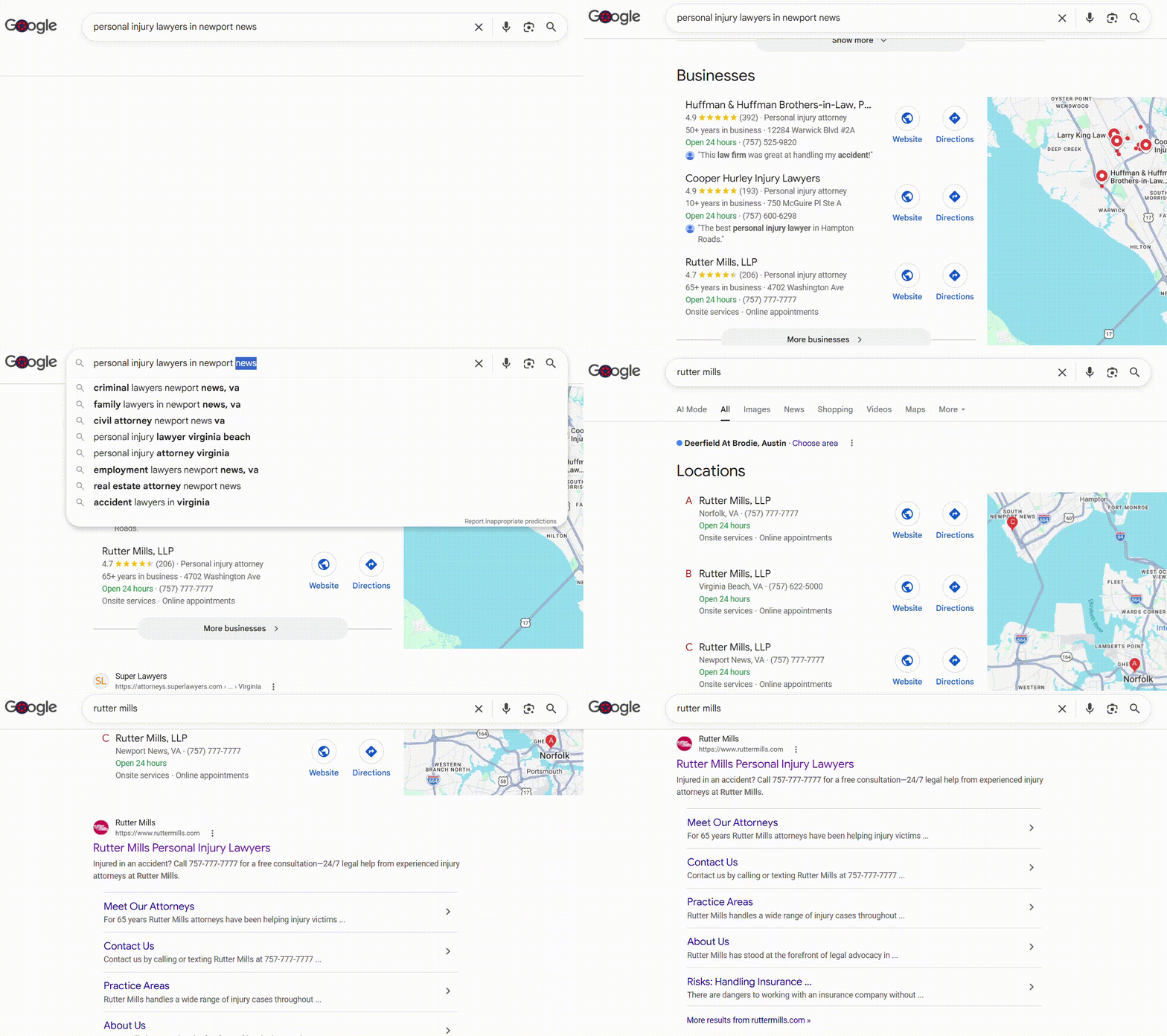
What to look out for: Manufacturing brand searches (for example, blasting out low-value job listings purely to spike searches for your firm name) manipulates a real search signal in a flimsy way that isn’t smiled on by search engines. Build your brand genuinely rather than luring searchers onto your site with a promise you can’t live up to.
2. Click Satisfaction (Navboost)
Google’s antitrust testimony also confirmed it uses aggregated click behavior, through a system called Navboost, to learn which results are actually satisfying to searchers. As a law firm, ask yourself: When someone clicks on your search result, do they get their answer and stop searching, or do they bounce back to Google and choose a competitor? “Bounces,” or clicks to and immediately away from your site, demonstrate a lack of quality and genuine usefulness, and they can hurt your performance.
What to look out for: Start each page with a direct answer instead of building up to it. Put case results and credibility where they’re seen immediately, make it as easy as possible to contact you, and cut out any filler. The “goal completion speed” concept you may have seen mentioned in other guides isn’t an official factor, but the underlying click-satisfaction signal it’s related to is real.
3. Topical Authority Through Content Clusters
Organized content clusters build and demonstrate authority in a particular topic more effectively than scattered, one-off blog posts can. For each practice area, build a pillar page supported by spoke pages for the specific questions, sub-types, and local variations your clients are likely to search for. Make sure all of these pages are internally linked to each other so Google reads the whole set as comprehensive coverage of the topic.
What to look out for: Map a full set of questions and sub-topics for each practice area before you start writing. You can use AI to help identify content gaps within your site, but make sure a licensed attorney reviews any substantive content for accuracy and proven EEAT.
4. AI Search Visibility
AI Overviews and assistants like ChatGPT, Gemini, and Perplexity now answer a growing share of legal questions before a user ever even thinks about clicking on a blue link. The same signals that earn traditional search rankings help with AI too, but there are a few specific user habits to be aware of. Most firms aren’t doing a great job of optimizing for the AI landscape, which gives you an opportunity to gain a lot of ground.
What to look out for: Start content sections with the direct answer to the user’s search query, use clear question-and-answer formatting, structure content with schema, and cite primary sources (statutes, court rules, government data) so AI systems can easily read and trust your content. Getting cited in an AI answer captures attention even when the user never clicks through, which helps with the brand awareness factor mentioned above and can earn cases on a longer timeline.
How Legal SEO Factors Work Together
None of the signals we’ve mentioned in this guide will work in a vacuum. Your Google Business Profile and reviews power local visibility, while deep, clustered content and authoritative backlinks build the topical authority Google expects for legal queries. On-page work, technical performance, and schema make sure search engines and AI can read and trust the content on your site. Brand demand and click satisfaction amplify everything by telling Google that real people seek you out and leave happy once they’ve found you. Firms that win their markets tend to be strong across all factors rather than excelling in some areas and ignoring others.
Where to Start
If you’re starting close to scratch, work from the top down according to the most powerful signals in our chart. Lock in your Google Business Profile and reviews first, since they’re the most important for both search and client awareness. Then build deep, clustered, attorney-reviewed practice area pages and earn authoritative links. Treat on-page and technical work as the foundation that your entire site sits on. Brand-building and AI visibility will come naturally as you complete some of this other work, and they also build up over time. Above all, remember your bottom line: You’re ultimately looking for a lower cost per signed case compared to what paid campaigns can give you, as well as a client pipeline that continues to grow as your site matures.
Turn Search Into Signed Cases
Want to know which of these factors is holding your firm back from succeeding in search? Our law firm SEO team can audit where you stand today, taking fundamentals and modern signals into consideration, and show you what it would take to own your market in both traditional and AI search. Reach out to Razor Rank for a consultation, and our team of experts and licensed attorneys will show you exactly how you can improve your standing in today’s search landscape.
Frequently Asked Questions
For local searches, which make up most legal queries, the most important factors are a fully optimized Google Business Profile, positive and recent client reviews, and consistent legal directory citations. For practice area and informational pages, attorney-reviewed content that answers clients’ questions conveniently, authoritative backlinks, and on-page optimization carry the most weight. Brand recognition and AI visibility are increasingly important on top of those fundamentals.
Evidence from Google’s 2024 documentation leak and antitrust testimony shows the importance of brand and navigational queries. A known, frequently searched firm tends to rank better than one that earns clicks from non-branded searches alone. You can improve in these areas by earning genuine recognition through press, awards, and a consistent presence. Just don’t “trick” users into clicking your links or put information into your search snippets that doesn’t represent what’s actually on the page.
Navboost is a Google system, confirmed in antitrust testimony, that uses aggregated click data to learn which results are most satisfying to searchers. Legal firms’ web pages should answer searchers’ questions quickly and thoroughly, and they should make the next step (calling you to begin the intake process) obvious, so visitors don’t bounce back to Google and pick a competitor.
Thin practice area pages and a neglected Google Business Profile. Firms without a lot of SEO knowhow also tend to chase broad national keywords, ignore EEAT, and overlook AI visibility as their prospects move to using LLMs more frequently, which leaves them vulnerable to competitors that are ahead of the curve.
Razor Rank is a full-service digital marketing agency specializing in SEO, paid media, CRO, and web. We help businesses grow through data-driven strategy and measurable results.