Google spent the last year moving AI Max for Search from an opt-in beta to the default state for a specific slice of Search campaigns. Standard, keyword-based Search campaigns (the setup most advertisers run) aren’t being force-migrated. What’s changing applies specifically to Search campaigns already using two legacy settings: campaign-level Broad Match and Automatically Created Assets (ACA). In April 2026, Brandon Ervin, Director of Product Management at Google Ads, confirmed AI Max had officially exited beta after about a year of testing with hundreds of thousands of advertisers, and laid out a plan to auto-migrate those two legacy setups into AI Max. That migration is happening now. As of September 1, 2026, Google began automatically upgrading eligible campaigns running campaign-level Broad Match or ACA into AI Max, with no opt-out once a given campaign is migrated. (Dynamic Search Ads campaigns were originally on the same September timeline but got a five-month reprieve to February 2027 after advertiser feedback about Q4 planning risk.)
In other words, if your Search campaigns are built on standard keyword targeting, this particular forced migration doesn’t touch you directly yet, but a lot of advertisers running those two legacy settings (and who never touched the “enable AI Max” toggle themselves) are about to get it turned on for them anyway. Before that happens more broadly, we wanted to share what we’ve actually seen in the accounts where we tested AI Max voluntarily, not as a verdict on whether it’s “good” or “bad,” but as a data point for anyone trying to figure out what to watch for once it lands in their own account.
What Is AI Max for Search?
AI Max is not a new campaign type. It’s an optimization layer that sits on top of an existing Search campaign. According to Google Ads Help, it’s a suite of targeting and creative features that continuously refines targeting and creative delivery using real-time signals. It bundles three things:
- Search term matching: An expanded, partly keywordless form of matching that goes beyond your built keyword list, using broad match and contextual/behavioral/semantic signals to decide when your ad should show.
- Text customization: Google’s rebrand of Automatically Created Assets. It generates new headlines and descriptions from your landing pages, existing ads, and keywords.
- Final URL expansion: Borrowed from Performance Max logic, this lets Google send traffic to a different, AI-selected page on your site instead of the fixed final URL in your ad, when it predicts that page will perform better.
Final URL expansion is on by default the moment you create an AI Max campaign, and it can’t be enabled without text customization also being on (keep this in mind if you’re trying to only test one feature at a time), per Search Engine Land’s rollout breakdown.
The September 2026 AI Max Migration: What Changed
A few important things have changed that advertisers who tested AI Max early, or who are about to have it applied automatically, will want to know:
- It’s no longer optional for a large slice of advertisers. Starting August 3, 2026, Google stopped allowing new Campaign-level Broad Match or legacy ACA setups to be created at all (in the UI, Ads Editor, and API). Beginning September 1, existing campaigns with those settings are being upgraded to AI Max on a rolling basis throughout the month, with search term matching and text customization are enabled by default. Legacy URL controls are preserved, but there’s no rollback once a specific campaign has migrated.
- Reporting has new dimensions. The search terms report now includes a source column (segments.search_term_match_source in the API) that separates traffic your own keywords earned from traffic AI Max’s broad match expansion or keywordless matching surfaced. Keep this front of mind if you’re trying to isolate what AI Max is actually contributing versus what your existing targeting was already doing.
- Google has published its own lift numbers that aren’t always backed up by outside testing. Google’s stated benchmark is around 14% more conversions or conversion value at a similar CPA/ROAS from enabling AI Max, with early case studies from L’Oréal (2x conversion rate, 31% lower cost per conversion) and MyConnect (16% more leads, 13% lower cost per lead) cited as examples. At the same time, some independent advertiser-side reporting circulating ahead of the September migration has described a much wider gap between platform-reported lift and account-level results, which is part of why testing your own account before (or instead of trusting) the industry averages is so important.
- New testing tools have shipped. Google Experiments now supports a dedicated AI Max split test (50/50 traffic between an AI Max campaign and a control), making it easier to isolate the feature’s effect rather than judging it off a straight before/after comparison the way we did below.
We’ve kept the coverage of the migration itself brief here since Search Engine Land, Google’s own Ads and Commerce Blog, and several other trade outlets are already tracking the September rollout in detail. What follows is specific to our own accounts, so that we can demonstrate proprietary results that are reflective of the verticals our clients care about most.
How We Tested AI Max
We ran AI Max in some of our accounts, and here’s what we found. Not every account had a usable pre-AI Max period to compare against (some adopted AI Max more recently, with no prior baseline in the data available). Rather than reporting each account as its own isolated case study, we’ve pooled the results below. The “AI Max active” figures combine every account we tested during the months it ran, while the “before” figures reflect only the portion of that pool that had a comparable prior period.
AI Max Results: Cost per Conversion vs. Cost Per Signed Case
| Metric | Pre-AI Max Baseline | AI Max active (combined) | Percent Change |
|---|---|---|---|
| Impressions | 242,100 | 148,898 | -39% |
| Clicks | 4,924 | 5,123 | +4% |
| Conversions | 282 | 360 | +28% |
| Signed Cases | 20 | 12 | -40% |
| Spend | $77,919 | $109,941 | +41% |
| Cost / Conversion | $276 | $305 | +11% |
| Cost / Case | $3,896 | $9,162 | +135% |
A few things stand out:
- Both conversion cost and case cost rose while AI Max was active, but not by the same magnitude. Cost per conversion increased about 11% during the AI Max window versus the baseline period. Cost per case increased about 135% over the same comparison (more than ten times the proportional increase on the conversion side).
- One of the tested accounts turned AI Max back off, specifically because cost per signed case had climbed to a level the team wasn’t comfortable sustaining.
- Volume didn’t ramp evenly. Within the AI Max window, spend and impression volume grew unevenly rather than at a steady rate (in one of the accounts newer to AI Max, spend roughly tripled from its first month to its second before leveling off, and conversion counts swung up and down month to month even as spend held flat). Signed cases, by contrast, stayed comparatively steady once they started appearing, and cost per case barely moved between two consecutive months even while cost per conversion more than doubled over the same stretch.
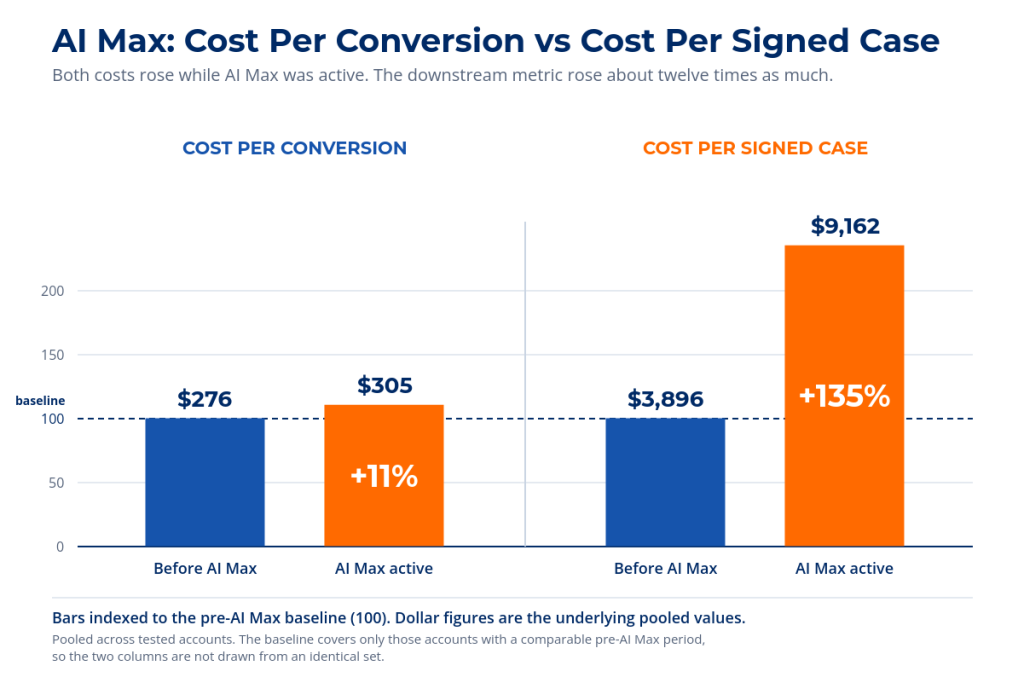
The gap between conversion cost and case cost is the most notable thing in this combined data. It reinforces something we already knew about search term matching and keywordless targeting: Expanding reach into a wider set of queries can add volume to a top-of-funnel conversion action (like a form fill or a call flagged as a “conversion” by Google’s tracking) without necessarily adding volume to the outcome that actually matters downstream (like a signed case, a closed deal, or a completed purchase). This is a smaller, pooled sample, so we don’t take it to mean that AI Max degrades lead quality broadly. It’s just a reminder that “conversions” and “conversion value” as Google reports them are not always the metric to make a go/no-go call on, particularly for businesses where there’s an important qualification step between a lead and a result.
What to Watch if AI Max Gets Turned On for Your Campaigns
We’re not drawing a broad conclusion about AI Max from a small pooled sample, and the data here is too small and too specific to generalize into “AI Max helps” or “AI Max hurts.” Here’s what we think you should know instead, especially if you’re about to have AI Max applied automatically to eligible campaigns starting this month:
- If your business has a qualification step after the tracked conversion (something like a sales call, an intake process, or an underwriting step), measure that outcome directly during any AI Max test, not just Google Ads’ conversion count. The pooled data above shows how “conversions” and actual bottom-line metrics can move independently.
- Use the new search term match source segment to see what AI Max really adds, rather than inferring it from before/after totals the way we had to here. Isolating AI Max-sourced traffic from your existing keyword traffic gives a cleaner read than just a month-over-month comparison.
- A 50/50 Google Experiments split test is better than a straight before/after if you have the traffic volume to support one (it controls for seasonality and other changes happening at the same time, which a simple before/after window like the one above can’t fully rule out).
- Give it more than a few weeks before judging it, and specifically make sure the test window covers a full sales or case cycle for your business, not just a full click-to-lead cycle.
- Be sure you know which of your campaigns are actually affected. Standard keyword-based Search campaigns are not part of this forced migration. If a campaign is specifically built on campaign-level Broad Match or Automatically Created Assets, though, Google has already begun moving it into AI Max automatically as of September 2026, whether or not you’ve tested it yet. We recommend auditing your campaign settings rather than assuming your entire account is affected.
If you want help understanding what’s going on in your Google Ads campaigns, whether they’ve switched to AI Max or not, get in touch with the experts at Razor Rank. We’re here to help you make sense of the recent changes and make informed decisions about how and where to put your ad dollars so they work the hardest for you.
AI Max for Search FAQs
AI Max is an optimization layer within an existing Google Ads Search campaign (not a separate campaign type) that combines expanded search term matching, AI-generated text customization, and final URL expansion into a single toggle.
For a specific subset of campaigns, yes. Standard keyword-based Search campaigns are not being force-migrated. But starting September 1, 2026, Google began automatically upgrading Search campaigns built on campaign-level Broad Match or Automatically Created Assets into AI Max, with no option to keep those legacy settings once a campaign migrates. Dynamic Search Ads campaigns are on a separate timeline, with automatic migration scheduled for February 2027.
In the combined, pooled data, cost per conversion rose modestly during the AI Max window versus the pre-test baseline. Cost per signed case rose far more sharply over the same period (one of the tested accounts turned AI Max back off specifically because of that rise).
No. Final URL expansion can be disabled on its own, but text customization and search term matching can still be active, and final URL expansion cannot be enabled independently of text customization (they’re linked settings within AI Max, not fully separable toggles).
This data isn’t a recommendation either way. It’s a small, pooled set of results, reported here to show what to watch for (particularly the gap that can open up between tracked conversions and further-down-funnel outcomes) rather than a case for or against enabling AI Max generally.
Razor Rank is a full-service digital marketing agency specializing in SEO, paid media, CRO, and web. We help businesses grow through data-driven strategy and measurable results.